Upcoming Events 2026
march
March 21, 2026
Welcome the Farmer’s Daughter,
Crystal Bowersox, to the Peanut Factory

Join us for an evening with Crystal Bowersox, a northwest Ohio native, who has built her world around music.
Chicago’s rich musical history helped Bowersox to broaden her musical horizons. Ultimately, Bowersox auditioned for the ninth season of American Idol, and her time on the show proved to be well spent. In 2010, her debut album, “Farmer’s Daughter” was released on Jive Records and since, she has since released 3 LP’s, two EPs, several singles, and is currently developing a theatrical rock concert titled, “Trauma Queen”. Crystal has recorded and performed alongside several notable names and additionally, has used her voice and talents to benefit several organizations close to her heart.
Purchase a $25 Ticket
No Show, Yes Donate
april
April 11, 2026
The Storyweavers

The Storyweavers are a powerful band of musicians featuring Sheela Fortner – singer/songwriter, Amy Ferebee – guitarist/vocalist, Cat Sprague – singer/songwriter/guitarist, Beth Whyle -bassist/background vocals, Robert Gibson – Percussionist, Jennifer McLaughlin – American Sign Language performance artist and Annie James – American Sign Language Interpreter. This band of musicians weave true magic with Americana flair, served with a side of Appalachian goodness. They are the winners of the 2024 Veer Music Awards in the Acoustic Folk category. Love. Hope. Blues. Pain. Soul. Celebration. Sit back and enjoy the ride…
Purchase a $25 Ticket
No Show, Yes Donate
May 7, 2026
Chatham Rabbits at the Peanut Factory

Join us for an unforgettable evening with Chatham Rabbits at The Peanut Factory!
Partners in life and music, Sarah and Austin McCombie have captured the adoration of fans nationwide and praise from Garden & Gun, American Songwriter, Paste and No Depression. Amid an impressive touring schedule, the two have already released four full-length records and somehow find energy to run their farm in their home state of North Carolina, a work ethic and connection to community that comes through in their songwriting. In 2020, the band played 194 neighborhood concerts as part of their concept The Stay at Home Tour, allowing them to connect with fans in a time of need. The following year, the duo caught the attention of PBS and filmed a limited series titled On the Road that is currently airing nationwide. Their fourth album, Be Real With Me, was released independently on February 14, 2025 and has been called “absolutely marvelous and beguiling” by No Depression Magazine and “a masterclasses in songwriting” by Americana Highways.
Purchase a $25 Ticket
No Show, Yes Donate
past events 2025
Friday, November 14th
Pack the Pantry Weekend: Thanksgiving Food Drive
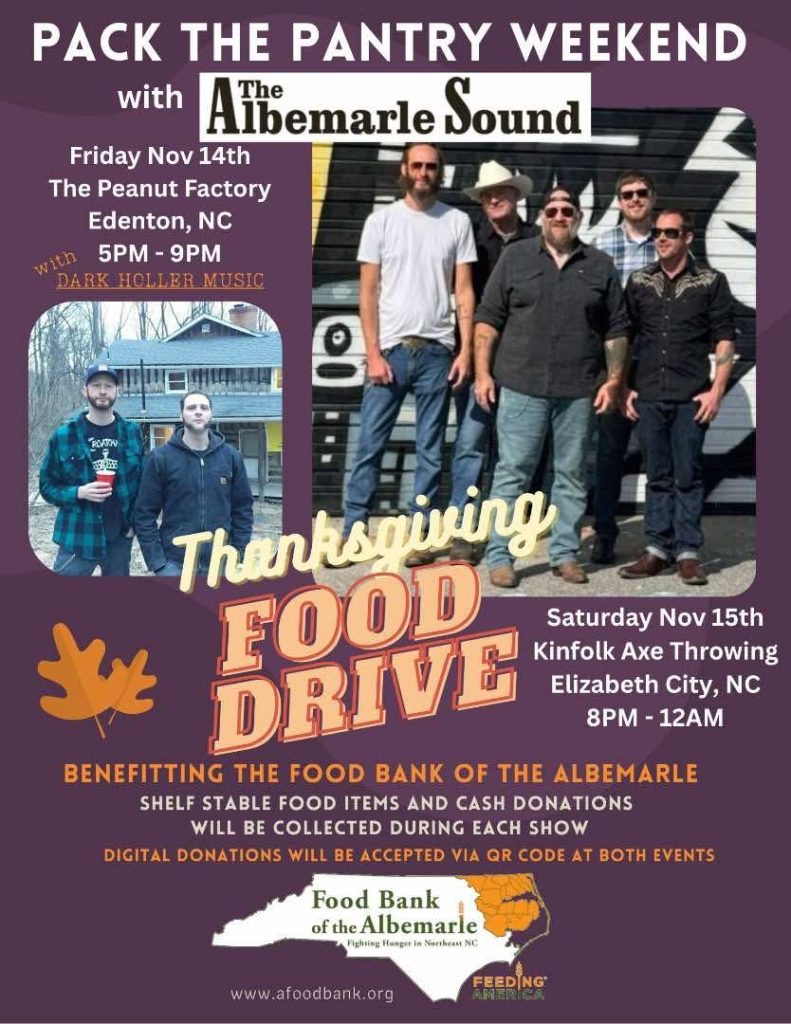
Saturday, Nov. 15, 5:30pm
Ladies Night at the Peanut Factory

Purchase a $20 Ticket
Sponsor Ladies Night
No Show, Yes Donate
‘Sherri Priester always delivers, and I laugh so hard it physically hurts,’ says one fan.
Comedian Sherri Priester from Virginia takes the stage for the first night of comedy at The Peanut Factory. Known as the Boss Queen, she will keep you laughing about marriage, family, and a whole life of experiences.
An outspoken champion of veteran causes, she is a comedy instructor at the Armed Services Arts Partnership in Hampton Roads.
The opening comedian for this show was originally planned to be the hilarious and well-loved Donna Lewis.We are very saddened to announce that she unexpectedly passed away at the beginning of November.
Army veteran and Hampton native Team Fred has stepped up to take her place at the last minute (even though it’s Ladies’ Night). Fred also conducts a seminar called “Humor Your Stress” that he gives to military/civilian to help deal with stress, anxiety and depression through humor.
To host the show, and share some LIVE MUSIC is the ‘Big H,’ a.k.a. Heather Helton, singer / songwriter from Elizabeth City.
Men are also welcome at this show, but it’s a night for the women. Come laugh, relax, have a bite at a food truck and enjoy the evening. Raffles and door prizes to be announced. First drink is on the house for the ladies!
food, beer & wine available
In a Nutshell: 5×5 Interviews
Artist in Residence:
Nancy Anderson
Interviewed by Cathryn Nicholas
CN – Thank you for taking the time to have this interview with me. I read a little about your journey and how you left your previous corporate career in exchange for your artistic adventures. It really resonated with me because I’m on a similar journey, so I was really excited to do this interview when I learned that. Please, tell me more about that.
NA – Well you know, spoiler alert, ‘nobody makes it out alive’ so we better love what we do, and that’s what was going through my head at 22 [years old]. What I say about it, too, is ‘you have to live your passion’, and be ready to know that you have to ride the wave. Sometimes you’ll be up on that wave, and sometimes you’ll be down, but hang in there and don’t stop swimming.
CN – Absolutely, I totally agree. Life is too short.
NA – Of course my passion is jewelry making, but what I love is the alchemy of metals; seeing a black dirty thing turn into this beautiful piece that people are willing to pay hundreds for. But what brought it up was going through a lot of down times, hard times, and difficult times where you just keep at it and don’t give up. From that has become my passion: ‘crafting your life from meaning’, so that’s where I’m at. I do a lot of teaching, a lot of workshops, I’m going to Africa with a women’s group that’s starting a school for girls in Uganda. So, it’s a national thing, but it’s also worldwide. I really believe that people want to help they just don’t know how. Most people don’t want to just write a cheque, they want to be involved and make a difference, and they want to make art, too.
CN – So, tell me how you began jewelry making, and how that took over your life; how did that start?
NA – So, I was a senior in college majoring in finance, and as you can imagine it was really tough and dry, the classes were boring, at least to me. Statistics, economics and math, etc. And from that, I took what I called a ‘recess class’, basically an elective, and I chose Jewelry Making. They had a jewelry facility at the University of Kansas, in Lawrence, Kansas, where I went, and I took this class and I was just mesmerized with it. And, I’ll never forget, my professor just looked at me, and he said:
“You’ve got this job offer at the Federal Reserve Bank of Denver but you’ve got this talent, look at this!”
And it was the first time anybody had steered me in that direction. This was pre-internet, pre-everything pretty much, and it was like ‘trial by error’. So, of course I ignored that calling because I got woo-ed in by the offer, moved out to Denver, which got me to Colorado, and then I was stuck in a cubicle. Literally just grey metal, high dividers; and I thought I had just died and gone to hell. So, I think I lasted about eight weeks because all I could think about was wanting to be with my friends, working in the shop again and making jewelry. I really think I was one of those lucky few that knew right off the bat ‘I don’t want to do this, and I know what I want to do.’ I worked all kinds of jobs after that, but while I was doing that, I had a studio which started in the basement next to a furnace, which is so dangerous when I think about it now, with torches and tanks, (chuckles) anyway, ‘I lived to tell!’ But, you know, just working my way up, making jewelry for my friends and family, and mostly self-taught. I think the key word is tenacity. I walked into Saks Fifth Avenue on Michigan Avenue when we were living in Chicago, and I saw the silver jewelry there, it was so boring – just banal – and I thought, ‘Ok, if they can do this, I can do this!’. So, I started calling and calling, and I would never get the ‘Yes’ people that can make the decisions, but finally I get through to her, and she says:
“Aw, well thank you, but we have a lot of silver jewelry already.”
And, I don’t know if it was just a lot of coffee that morning or what, but I said:
“Well, if I can have ten minutes of your time, I’ll show you something different, I promise.”
And she stopped, and I said:
“How is Friday at 10:30?”
and she said,
“Oh, okay, sure!’”
So, I get in the door, with a baby in the stroller, my daughter, and I pulled out the few pieces I had to my name. Then she gets on the phone and she calls a woman, and says ‘You have to see this, come down here.’ And from that, it led to 10-15 Saks Fifth Avenue stores around the country. Then it was like, oh! Suddenly, I have a business!
CN – Incredible! I can’t help but wonder then, how did you get involved with The Peanut Factory?
NA – I did a cross-country trip, I have an AirStream trailer named Silver Savior and I decided to go from Colorado, travelling across the northernmost tip of the US to Maine, and then come all the way down. A friend of mine had moved to Edenton, and she invited me to come see her. So, I kind of based the trip around friends, and interviewing artists. So, I get to Edenton, and of course fall in love with the little town, and I go into the art center there, and I tell them what I’m doing, and I’m interested in classes, and working with the community. And they said, ‘Well, you need to meet Julia at the Peanut Factory!’ So, without an appointment or anything, I drove the Silver Savior over to the Peanut Factory and proceeded to fall in love with her and her vision, and her father-in-law, and just everything they’re creating there. I mean, honestly, it was about my favorite stop on the whole trip. Then, I got to my mom’s, near Raleigh, well, Fayetteville, and couldn’t believe it was only about two hours from them, and told them how wonderful it is. I just fell in love with it, the scenery, the people, the affordability, and everything. And, from that, Julia and I stayed in touch, and I said, ‘Hey, let’s do something together!’
CN – Tell me, is that something the “Shrine of Intention”, Guardians of the Light workshop?
NA – Yes! The Shrines of Intention and kind of ‘Day of the Dead’ workshop commemorating someone you love, or a pet. Both of us just have this love for found art: found objects, rusty metal, and all that good stuff. So, when I got their tour of The Peanut Factory I just fell in love with everything they’re doing there. There are very few places like that anymore in the country; they’ve all become so gentrified and expensive, so I just want to support them.
CN – Last but not least, I feel like we could go on forever, but what is the greatest gift that you received from pursuing your endeavors in jewelry making and travelling and all the experiences you’ve had?
NA – Wow, um, I think for me it would be community. In my lowest of low times, like when the pandemic first broke out, or I hard financial times, or working through 9/11, through the ‘08/’09 recession; through it all is a family that I’ve created with others around the world, not just the United States. So, it’s definitely community – without people we are nothing. We are better together, and in this time of division it makes my work even more important. I have such a passion about creating community. It breaks my heart to see young teens doing nothing but looking at their phones, not talking, not creating, not enjoying a sunset. So, that’s my mission. It’s all about community and people. The art and the jewelry making has afforded me this family that I’ve also created on social media; a creative outlet where I would go on video and people would join – because everyone’s looking for community.
CN –Well, thank you so much for interviewing with me, it has been such a pleasure talking with you, learning more about you, your experiences, and Sweet Bird Studio.
Cathryn Nicholas lives in Fort Lauderdale, FL., and is currently a master’s student in interior architecture & design at Academy of Art University. She is on a spiritual journey, practicing complete sobriety, and loves all things artistic and creative.
events 2025
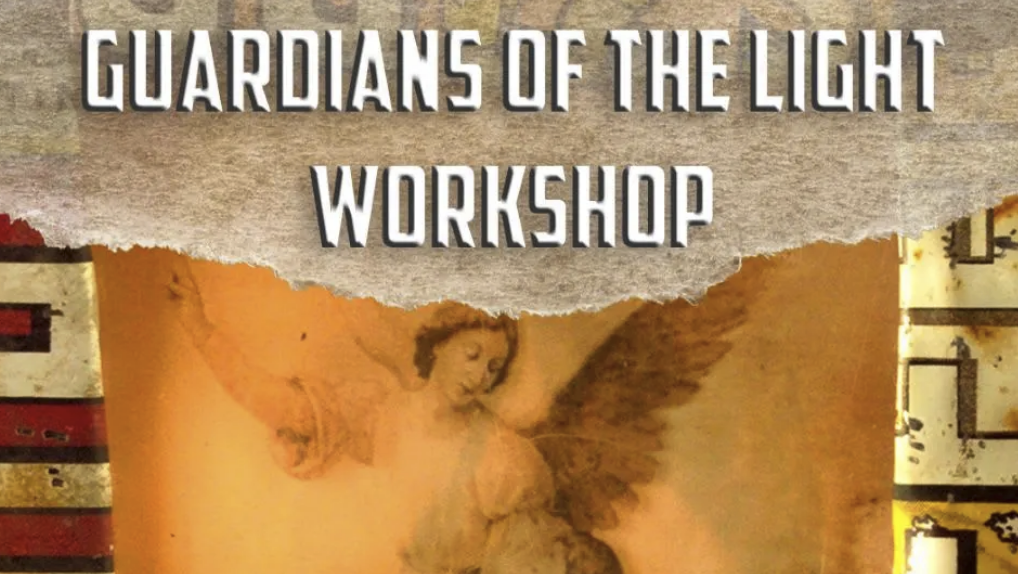
Guardians of the Light Mixed-Media Workshop with Sweetbird Studio’s Nancy Anderson
October 9, 4:00 PM – 7:00 PM
Location: 916 Badham Rd, Edenton, NC 27932, USA
Click here to Register >
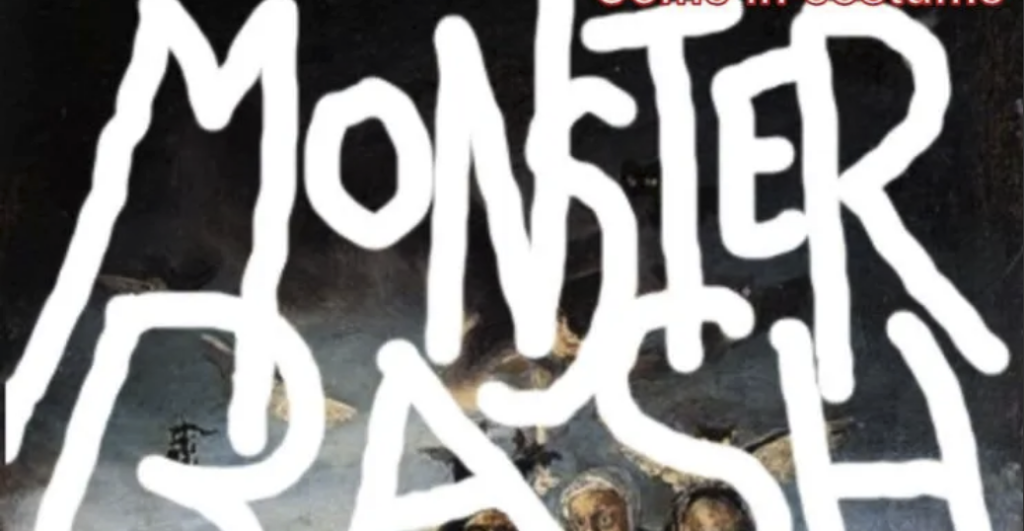
MONSTER BASH Live Music with Crabpot Creek & the John Stolarc Trio
Attention all ghouls, ghosts, witches, warlocks, zombies and monsters in all shapes and sizes: Come hear CRABPOT CREEK for a Halloween MONSTER BASH, with the JOHN STOLARC TRIO opening the stage. Prizes for best costumes! Come bob for apples and dance around the witches’ cauldron. Enter a raffle, enjoy the bar and food truck. Doors open at 5:00, music starts 5:30. Tickets 10$, $15 at the door.
Oct 25th, 5:00 PM – 9:00 PM
Location: 916 Badham Rd, Edenton, NC 27932, USA
Click here to Tickets >
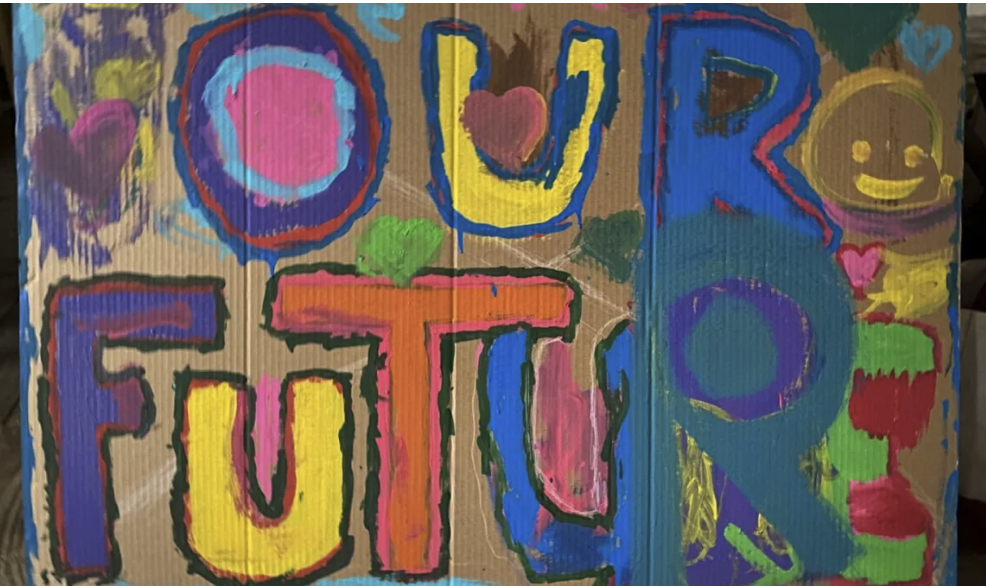
Painting and More in October
Cultivate your child’s creativity. Join us every Wednesday afternoon for 6 weeks this fall to let your child paint, draw, build…make things!. Some projects will be made individually and can be brought home, while other projects will be made by the group. There will be aprons available, but your child should wear old clothes. A small snack and drink will be included.
Activities are designed for children ages 5-7. Older children are definitely welcome too, and projects will be adapted as necessary.
— Attendance is limited to 10 children.
— A parent or guardian is required to stay with the group during the entire session.
— On Wednesday, November 19, we would like to have a small reception to showcase the children’s works.
Every Wednesday, October 8, 15, 22, and 29.
Location: 916 Badham Rd, Edenton, NC 27932, USA
Click here to Register >
Monthly Watercolor Workshop Fall 2025
Hello watercolor enthusiasts! This is an extension of the 2025 monthly watercolor series. It will take place again from 5:30 – 7:00 pm on the 2nd Monday of each month, from September 2025 to February 2026. You can pay as you go, or get a better price when you purchase all 6 sessions at once.
Location: 916 Badham Rd, Edenton, NC 27932, USA
Click here to Register >
In a Nutshell: 5×5 Interviews
edition 01: 07.25.25
With Jamie Davis, interviewed by Nancy townsend
NT: Good morning, Mr. Davis! I’m going to start firing away – your time is probably precious. I learned you were born in Jacksonville, NC?
JD: Yes, ma’am, born and raised.
Can you list off some of the places you lived, due to your father’s military life, outside of North Carolina?
I lived in Hawaii, Virginia, and South Carolina, then back to North Carolina.
NT: Wow, so you all got around. And how old were you when you returned?
JD: I moved to Hawaii when I was maybe one, came back to North Carolina when I was four, stayed for a while in Virginia, came back…no, no, after Hawaii I went to South Carolina then came back to North Carolina, went to elementary school, then middle school…yeah, so…My ages varied, but the majority of time, I remember North Carolina. You know, my mom’s from Maple Hill, North Carolina, which is in Pender County, so North Carolina is really everything I really remember as a kid.
NT: What was the first memory you have that told you, wow, food can be amazing and surprising?
JD: I think it was just growing up in Maple Hill, North Carolina, cooking whole hogs with my grandfather, seeing how excited everybody was when we did it and how it brought the whole community together. So, say, I was probably six or seven, cooking whole hogs in Maple Hill, North Carolina with my grandfather.
NT: Was that where you piled up the wood…did you use wood or coal and wood, or what did you all use? My grandfather, he grew up in Ayden, North Carolina, so it was wood and he built pig cookers. So we would feed the pig-cooker wood and sit out there all morning, or all night, really, and just cook the hog.
NT: Yeah, it’s kind of an all night thing, right?
JD: Yes, ma’am.
NT: And then people would show up at midday.
Yes, ma’am, and just start pickin’-off, and we’d pull off some of it and chop it, ‘cause down there, they did chopped barbeque, but I worked at Smithfield’s Chicken and Barbeque where we hand picked it and pulled it with our hands. So growing up we used to chop it.
NT: So that was kind of a solitary thing with you and your grandfather at night, and then to see all the community gather ‘round, that must have been kind of amazing.
JD: Yeah, yeah it was.
NT: We’re getting down to the last couple of minutes… Can you name three things that make you love Eastern North Carolina?
JD: Three things… Water. I love being surrounded by water. Barbeque. Pulled pork, I just love pulled pork. And, this is where I’m from , you know, and I’ve been a lot of places, but nothing’s been like Eastern North Carolina to me. Being born here, my memories here as a child, now my kids are growing up in almost a similar environment, so I think it’s the legacy of Eastern North Carolina to me that I just love.
NT: That’s beautiful. I have no doubt that as a chef you work close to 24-7-365…
JD: Yes…
NT: And yet you’re taking time out to help my sister and her husband at the Farm’s Fig Festival. Why do you think it is that the greatest chefs go about cooking food with nearly a religious type of fervor?
JD: Well, the way I explain it to people: God has blessed me a lot, and God has blessed me, and sometimes you have to do things, you know …When you put good out, you receive good. Every event, you can’t say, what’s your budget? Sometimes people are just honest, Hey, man, we don’t have a budget, but we would love for you to come here. For me, man, I’ve been blessed so much, what’s a day? You know, what’s a day giving back to the community, giving back to good people, man, everything’s going to come back. So you put positive out and you receive positive. I really feel like everybody is not a Hackney [the restaurant where Mr. Davis is Chef] clientele – we’re pretty upscale – but I like to show people we’re all human, we all like good food, man, and I just like going to communities where those people probably won’t ever step foot in The Hackney because they feel like they can’t . I like to show how approachable we really are. Just for me, personally, to be honest, God has blessed me with a beautiful career, a beautiful life, a beautiful family, so I have to keep sewing seeds so the next person can get blessed also. If that makes sense.
NT: It does, totally, make sense. And along those lines, my sister said she asked you how you could be so generous and she said your answer was that a lot of people gave you a hand along the way.
JD: Yes.
NT: This is your last question, by the way – can you tell us about a couple of those people who were so generous to you?
JD: Growing up, my dad was a marine so he was gone a lot. The years that I think that I really needed a male figure my dad wasn’t home. He was in New York, he got stationed in New York and I was in high school, I was finishing my ninth grade year. So my first boss at Smithfield’s Chicken and Barbeque, Mr. Jimmie Monteith, he gave me a lot of opportunities and he gave me a lot of chances, even when I didn’t deserve them. He always looked out for me, so I feel like…
NT: He was a neighbor?
JD: No, he was my boss at Smithfield’s Chicken and Barbeque, but he was like my father. He helped me get dressed for the prom. When I was messing up with school he would be tough on me and explain to me why I had to be good at certain things, and he just showed me…something that my dad wasn’t around…I’m not saying my dad was a bad dad, it’s just he was always gone. So Jimmie Monteith took the time to actually mentor me. And I worked under a lot of chefs that really gave me grace and really pushed me. So without them, I wouldn’t be anywhere so I really feel like I have to, you know, repay the Universe by doing the same thing, you know. Everything’s not about a dollar with me, it’s about, Hey, am I leaving an impact, how these people impacted me, am I helping the community? And, so I just try to help out as much as I can.
NT: That’s really beautiful. We’re done, by the way. That was seven minutes instead of five.
JD: No worries.
NT: Thank you, it’s been an honor and it’s been a true pleasure of mine to be talking to you. Thank you so much.
JD: Well, thank you. You’re welcome. I really appreciate you.
Nancy Townsend teaches math at Lumberton High School. Previously, she cooked at the North Carolina Museum of Art, and at ‘The Pit’ Authentic Barbecue in Durham, North Carolina.
edition 02: 07.27.25
With brad johnson, interviewed by raymond prucher
RP: Hi Brad, thank you for taking the time to chat with me today.
I know you have roots in the area, but have followed several opportunities leading to both culinary and musical careers. Can you speak to us a bit about your journey?
BJ: I grew up in eastern North Carolina working in restaurants all the way through school. I eventually opened a restaurant here in North Carolina, then took a job in Pittsburgh in food service distribution. My daughter and I performed at local venues in Pittsburgh as an acoustic duet called the daydreamers.
I grew up in a musical family. My mom was the choir director of our church and my dad sang in the choir. My brother plays several instruments. It’s always been in my life. Crab Pot Creek feels like the culmination of all those years of playing music.
RP: It seems that something shifted your priorities. What led you back to your family farm? What are your goals and visions for the farm?
BJ: Pittsburgh is a very nice city, but for several years now I have wanted to come back home. I’m a small scale produce grower and I sell at my local markets. My vision for the farm is to grow healthy food for myself and my community.
RP: Do you feel there’s a relationship between your farming and your music? Are they tied together for you in any palpable sense?
Yes, the farm and my music are very tied together. Both are opportunities for creative expression and community involvement. Both are very dear to my heart and they help each other.
RP: Tell us about your band Crab Pot Creek. How did the band get started and where do you see it heading creatively?
Crab Pot Creek is the culmination of years of music from all members. My brother Chip plays bass, and my friend Matt plays drums. We have all spent countless hours becoming proficient at our instruments. For that reason we’re able to come together and write music without any egos involved. We are all focused on the songs themselves and the results are amazing. We all three bring unique perspectives to the band.
My brother Chip comes with lots of experience in country, rap and Christian music. Matt, the youngest member of the band, has an old soul and loves to deep dive into old jam bands and forgotten tunes. My focus has always been Americana rock and roll — the songs you love to hear on the radio. We are less than a year old as a group, but our focus is continuing to build a fan base and playing music that everyone can enjoy.
RP: Lastly, what can we expect from Crab Pot’s performance at the Fig Fest?
BJ: Crab Pot Creek’s performance at the Fig Festival will be a 50/50 mix of original songs and cover songs that you know and love. We put the setlist together in a way that makes you feel like our original songs sound familiar. We can’t wait to play for the community. Spruill Farm is one of our favorite venues!
RP: Thank you again for sharing a bit about and your journey. We look forward to jamming out with you and the band at the 3rd Annual Fig Festival on August 10, and watching where you take things into the future.
Raymond Prucher is an Creative Director, Designer, and Artist. He is the founder of Szossari fashions for a cause, and was an Artist in Residence at The Peanut Factory in 2024.
edition 03: 08.01.25
with alyssa Archer, interviewed by DR. mary flaherty
MH: I’m so happy to be here with Alyssa.
We’re going to have a little chat about yoga, five questions, five minutes. My name is Mary…
MH: So I’m going to kick it off with a big open question, what got you into yoga in the first place, Alyssa?
AA: Yeah, I have a hard time remembering the exact moment, but for me, it was just something that I did in high school alone, just watching YouTube videos. And it’s just the one thing I could find that made me feel grounded throughout that time in my life when I was having a lot of anxiety and it just. Yeah, I loved it.
MF: Fantastic. And how did you come across it?
AA: I don’t necessarily remember exactly how it happened, just online. I think I was getting into meditation. And then found yoga. And then I time I was on Instagram actually, and I saw this ad to go backpacking in India. Great. So then I went and that’s where I took my first yoga class in Rishikesh.
MF: I love it. You went straight to the source. That’s fabulous. And Rishikesh is quite the place. That’s fabulous. What a great story. Excellent. First class of yoga in Rishikesh. That’s a landmark.
When I was researching my book about yoga, what I really understood was that yoga means so many different things to different people. So what does it mean to you if you can give us an outline?
AA: Right. It’s so interesting because I feel like if you ask me each year of my journey, like, I feel like I almost have a different answer. It’s like the layers keep peeling back. Right now, as simple as it is, I feel like it just just means to unify. So it’s bringing together these separate parts of self, and it’s bringing together the body, the mind, the soul, and all these fragmented pieces. And it’s just a practice where you’re devoting yourself to bringing that back together again and again.
MF: Well, that’s beautiful. I love the way you say that the layers, it’s almost like a lasagna you’re going through one layer to another layer and it gets deeper and deeper, which is beautiful. That’s really nice. And a great journey of discovery as well, both for yourself and for your students.
Speaking of your students, is when you teach a class, when you’re presented with a group of of people or a one on one, what do you want the people or the person to go away with? Like imagining maybe that you’re that student coming to yoga for the first time? What do you want them them to go away with?
AA: I think that more than anything, I want them to go away with a sense of empowerment to be with themselves and to have a relationship with self. because there’s so many distractions, there’s so many ways to avoid sitting with ourselves. And it’s so easy to analyse and feel like, oh, this person can help me. Even when it comes to looking at certain yoga teachers, like thinking they have the answer, when really we’re just facilitating a space for you to realise like, it’s all coming from you. So I just want people to feel empowered to connect with themselves and to sit with whatever’s showing up for them.
MF: That’s such a beautiful idea because in our world at the moment, with social media as one, it’s so external, and it’s so great to give people a venue where they can do the opposite and begin to look inside and, you know, enrich that relationship.
How do you see your role or your mission as a yoga teacher?
AA: Yeah, maybe these questions sort of bleed together for me. It’s just for me, like creating a safe container, creating a safe space, as well as adding a little bit of inspiration and pushing people a little bit. I do like to challenge and I like to be a bit more hands on in my classes if I can, for people who feel safe and comfortable with it, because I think that’s what makes in-person classes so wonderful is when you have a teacher there that can sort of change the way the pose feels for you and just push you a little bit further.
MF: Great. I’d like to be in your class. Sounds great.
And for you personally, what’s the greatest gift do you think yoga has given you personally?
AA: Wow, that’s good great question. I think that yoga has given me a sense of confidence, and I think that yoga has also given me ability to connect with other people deeper and to hold spaces for people outside of yoga classes. Yoga classes used to be the only place I felt comfortable holding space, but I’ve kind of seen it ripple out into my life because as my relationship with myself has deepened a bit through my yoga practice, it has allowed me to show up more fully for other people. It’s just this mirror, this reflection. And I think that’s been the greatest gift.
MF: Oh, fantastic.
AA: I could probably ramble for a while.
MF: That’s as good as it gets, really. What more could a person want. We’re always with ourselves forever. So it’s the most important relationship we’ll ever have. So that’s a beautiful statement.
Now, it’s five minutes, so thank you so much, Alyssa.
Dr. Mary Flaherty, psychologist, is the author of Does Yoga Work? Answers from Science. Her passions are yoga, flamenco and walking in nature.
Winter Pruning Workshop
Saturday, Feb 8 at 2pm.
On Saturday Feb 8th, we’ll offer a pruning demonstration and Q&A at the Spruill Farm presented by long-time Spruill Farm volunteer, plant nurseryman, and naturalist Clay Coor. The focus will be on fruit trees including blueberries and figs, but we may discuss muscadines, roses, or flowering shrubs if the opportunity arises. Bring your shears and your questions as we shape the fruit trees and bushes on the farm this winter.
2024
August 14-21 Artist in Residence Raymond Prucher from NYC.
Raymond Prucher is an artist, designer and writer. With degrees in painting and creative writing, he is comfortable in a broad range of traditional media – painting, drawing, printmaking, sculpture and ceramics – as well as digital media. He has edited and published the online literary journal, whimperbang.com, since 2003, recently organizing a reading at the New York Poetry Festival’s Blackbird stage on Governor’s Island in NYC. During the day he works as an art director for clients in a range of industries. He has taught art, design and creative advertising at the American University in Dubai, as well as other schools abroad and in the New York City area.
Register for his workshop HERE
August 11, 2024
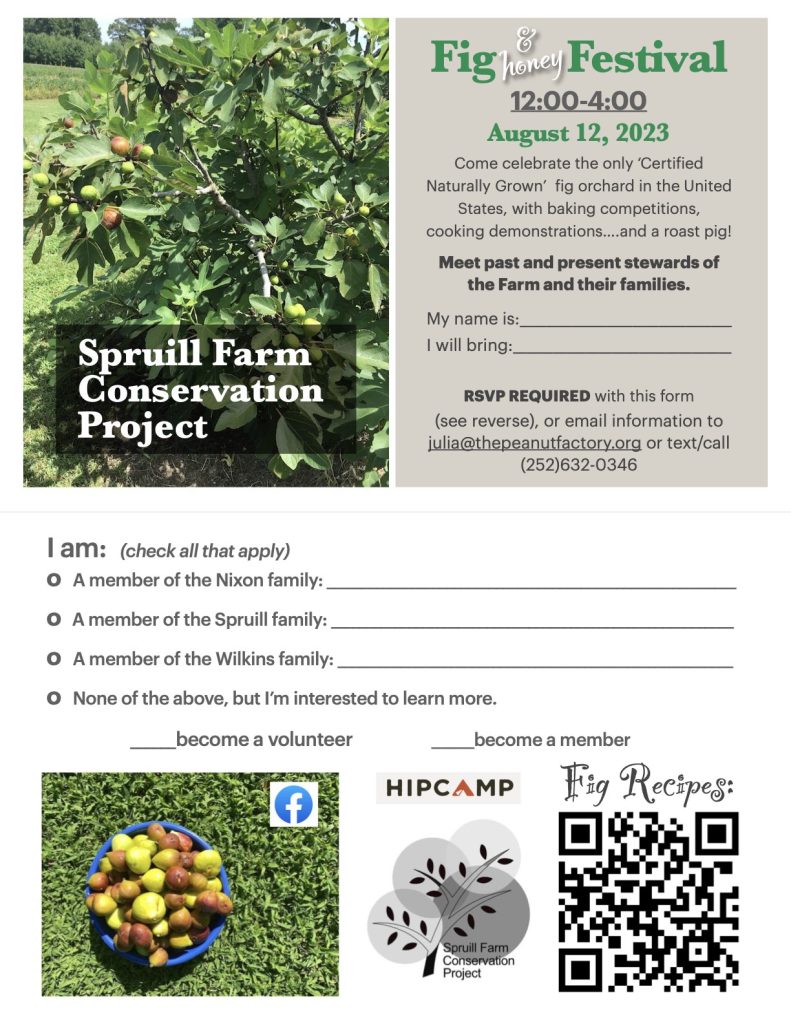
The 2nd Annual Peanut Factory Fig Festival
Located at the Spruill Conservation Farm in Roper. Pictures to follow soon.
Schedule:
6:00 am Yoga by the Fig Orchard with Yogi Alyssa Archer from Moyock
7:30 am 5K perimeter trail run
1:00-4:00 fig tasting, fig picking, pig roasting, etc.
2:00 Guest Executive Chef Jamie Davis from The Hackney Restaurant demonstrated braised duck on a bed of risotto with fig sauce
‘Crabpot Creek’ played Americana Rock n Roll
3:00 tasting of the entries: fig preserves, sauces, and baked goods
3:30 prizes awarded: ‘Copa de Figo’ for people’s choice, Chef’s choice (3 -man chef team) ‘Best Preserve,’ ‘Best Baked good’, and ‘Most Original.’
June:
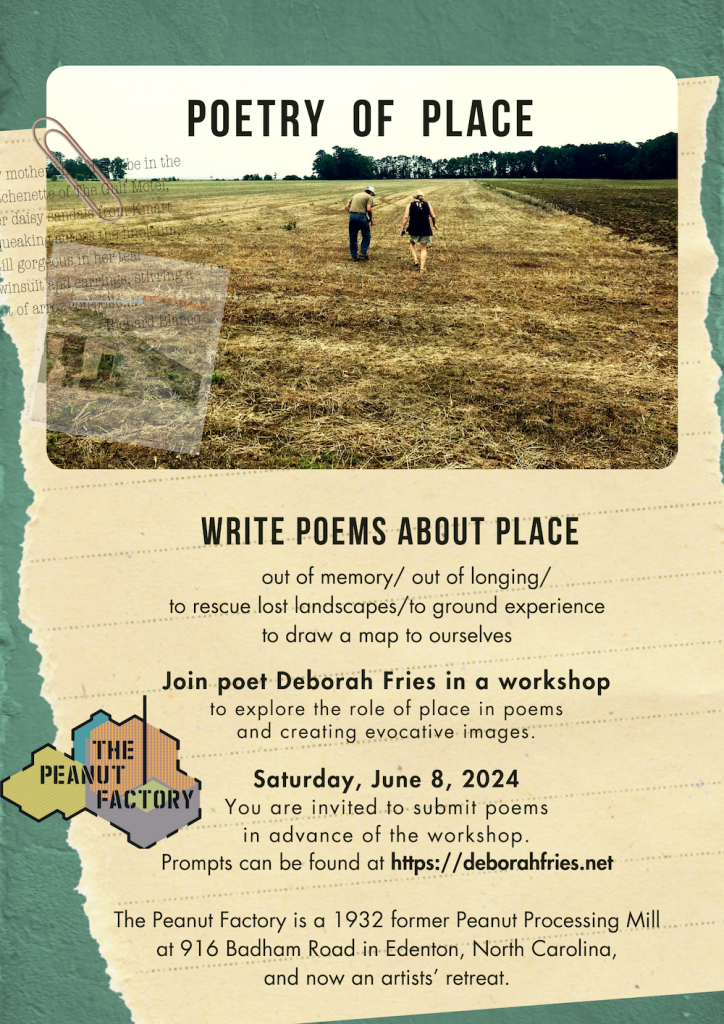
Submit poems now through June 3rd. Prompts are here.

INTERVIEW with DEBORAH FRIES
Where are you from, and how did you come to publish several books of poetry? You have advanced degrees in English. Has writing always been a passion since childhood?
I grew up in a small town in western Pennsylvania, where I was lucky to have good English teachers. In fact, my high school produced two well-known novelists of my generation – Dean Koontz and David Bradley.
For several decades I lived in Milwaukee and thought of myself as having a Midwestern sensibility. Today, I don’t even know what I meant by that, but it had something to do with the subtle beauty of the flat land, Lake Michigan and being thought of as a flyover by more sophisticated literary communities.
Wherever I’ve lived, writing has always been important to me. I’ve made a living through the written word in journalism, public relations, editing and teaching.
And although I began publishing poetry in college, it wasn’t until I moved to Philadelphia in the Nineties that I decided to get serious about publishing. I was in my fifties when Carolyn Forché selected Various Modes of Departure for a first book award and publication by Kore Press.
The poetry writing workshop that you will hold at The Peanut Factory (on the same day as the Poetry Reading) is titled ‘Poetry of Place.’ How does this place- Eastern North Carolina- resonate with you?
My maternal ancestors first settled in Washington and Tyrrell counties in the seventeenth century. I didn’t understand how deeply rooted I was in Eastern North Carolina until I became interested in genealogy about 15 years ago. What I did understand was the concept of down home, a place that my mother, transplanted in the North after marriage, rhapsodized.
Time seems fluid in some of your poems, maybe those with narratives. Memories come forward, or mesh with the present tense, or foreshadow an event. Do you think consciously about the linearity of time as you organize a poem?
There’s a lot of unconscious organization that goes into an early draft of a poem, and sometimes it works. In a poem like “Leaving Whitefish Bay,” I end the poem with an image that felt right. Consciously, it captures an anecdote that has stuck with me since the Nineties and illustrates a past when German sympathies were rampant in Milwaukee. So, I was writing this poem from Philadelphia in 2000 about something I heard when I lived in Wisconsin in 1992 that happened in the 1940s, and even today, it is a living image for me, one that represents the often futile condition of returning.
You have written about personal experiences, Marie Curie, Robinson Crusoe, among other topics. What actually prompts or inspires you to write a poem? Is there anything about your technique that you’d like to share?
I am interested in a lot of things and now appreciate the decades I spent apart from academia, although for a long time, I thought that’s where I belonged. Divorce pushed me into day jobs as a business reporter, and as a government public affairs officer for both a transportation agency and an environmental protection agency. The vocabularies of those occupations found their way into poems. There were always images from those jobs that I wanted to share: a migrating plume of underground petroleum contamination, Marie Curie visiting a Pittsburgh radium factory in 1921, the entrainment of small fish at the power plant’s intake.
What I’d share with others is an awareness that there is always a metaphor in our daily lives worth writing about. That which holds our attention offers us a poem. We don’t have to look for it. Whether it’s a car accident we pass on our way to work or a news story about feral hogs, there may be a poem within.
Over the last decade, approximately, you have become a visual artist also, with a specialty in monoprints inspired by landscapes and natural forms, such as crepe myrtle or dogwood. Visually, many of your images have a mistiness to them, devoid of people or structures. They seem to be more about the atmosphere than the terrain. Are you able to think visually in the studio, or do you verbalize (in the mind) as you create pictures?
I began college as an art major, but could never execute the work that I imagined, and switched to being an English major, where, as a graduate student in creative writing, I could edit and revise until I was satisfied with my creation. I returned to printmaking in 2000 with the mindset that I was not invested in the outcome, that making art was only a form of recreation.
But beginning in 2018, I was offered a solo show, and another, and another, and today I think of myself as straddling both visual and verbal forms of expression. And wanting to combine them.
The first time someone called my artwork atmospheric, I was puzzled. In my mind, I am grounded in the literal. I do have some work with structures, but often in the distance. I’ve worn glasses since I was seven, so the way that details are forfeited is normal to me. In the studio, I am thinking visually. There are no words in my head about where the horizon should go or how to mix the right green.
Is your workshop at The Peanut Factory on June 8 open to beginning poets, or people who have already been to some workshops or creative writing classes? What kind of students do you usually teach?
My workshop at The Peanut Factory is open to beginning, intermediate and advanced writers. We can all benefit from understanding why a place is important to us, what it represents, and which selective details can make our subject evocative.
In recent years, I have offered multi-genre workshops to adults who had the option of responding to thematic assignments in poetry or prose.
You’ve had an impressive career as an editor. Can you tell us about editing the anthology Powder: Writing by Women in the Ranks, from Vietnam to Iraq, or another publication/collection that you enjoyed? …and if/how it feeds into your own creative work?
I was not an editor of Powder, just a contributor.
In 2020, I edited a memoir, When the Alphabet Comes, the author’s story of his fall from grace when it was revealed that he’d accepted a bribe as the coach of men’s basketball at U Penn. Our accidental meeting in 2018 became an ongoing relationship that has not only introduced me to other editing clients in the world of basketball – it’s also expanded my interest in helping new writers find their voice.
An excerpt from “Leaving Whitefish Bay”
This is where I lived before I left for good: in an undistinguished
house on Diversey Boulevard, where one night a transformer blew
and showered my lawn with sizzling oil and bits of fire, where
I planted mallow and cosmos and day lilies after the cleanup;
where I lived next to a woman who told me the story of her uncle,
a German, who left Whitefish Bay to be a Nazi and disappeared forever.
He told her to wait at the beach, that one day he would return from the sky,
posted home in uniform, a crisp package carried by a clean, white parachute
who’d come back soon, gliding lower and lower over the dark blue bay,
landing in the sand at Klode, greeting her in English as if nothing had changed.
March-April-May project is ongoing:
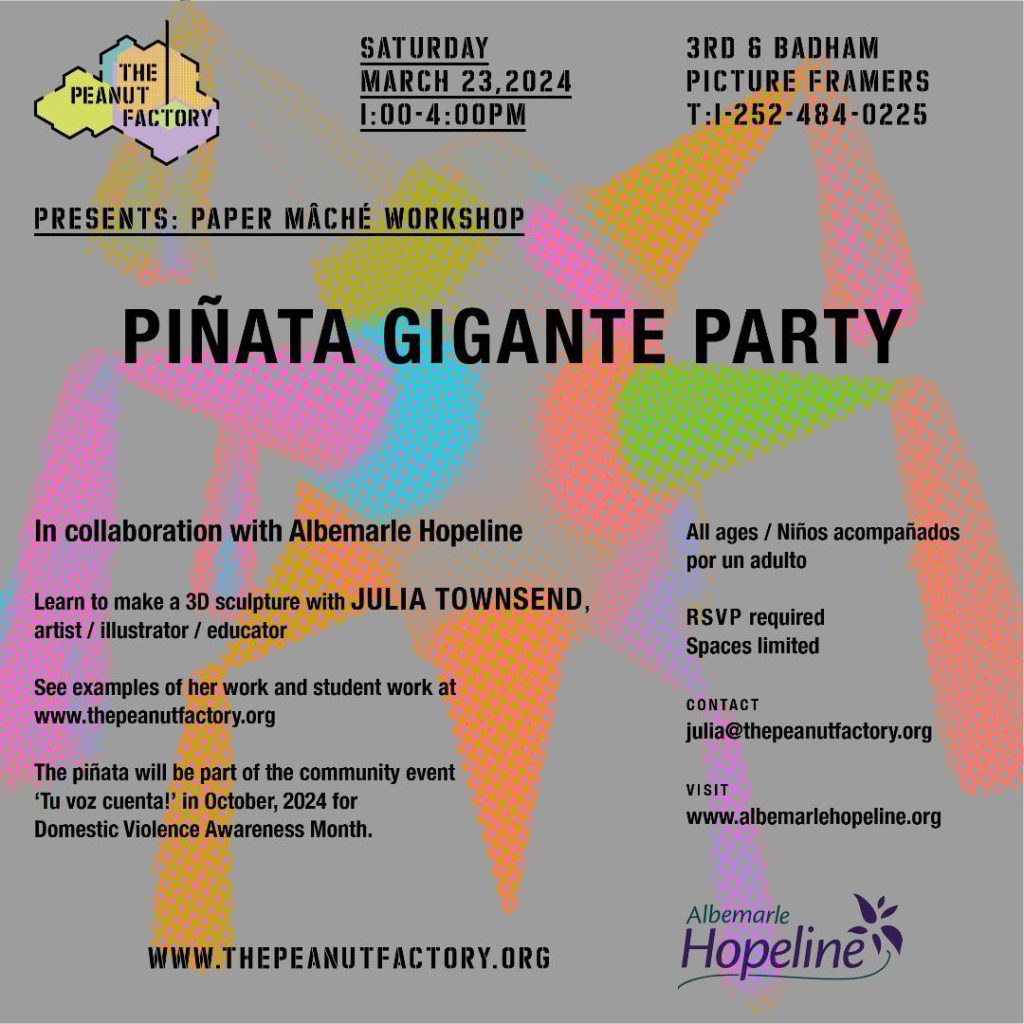
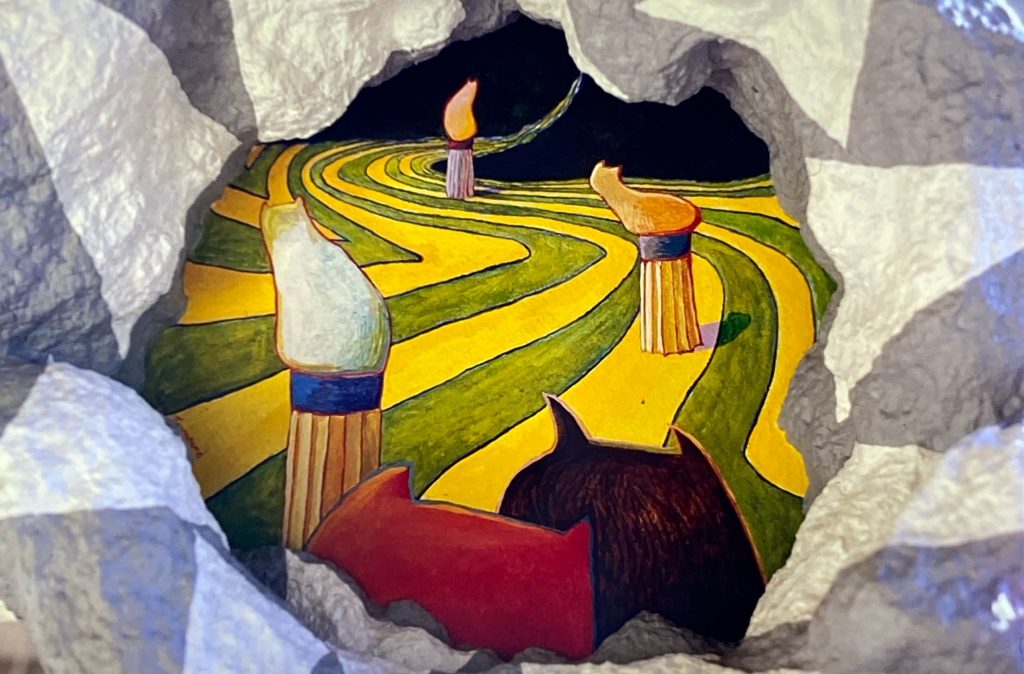
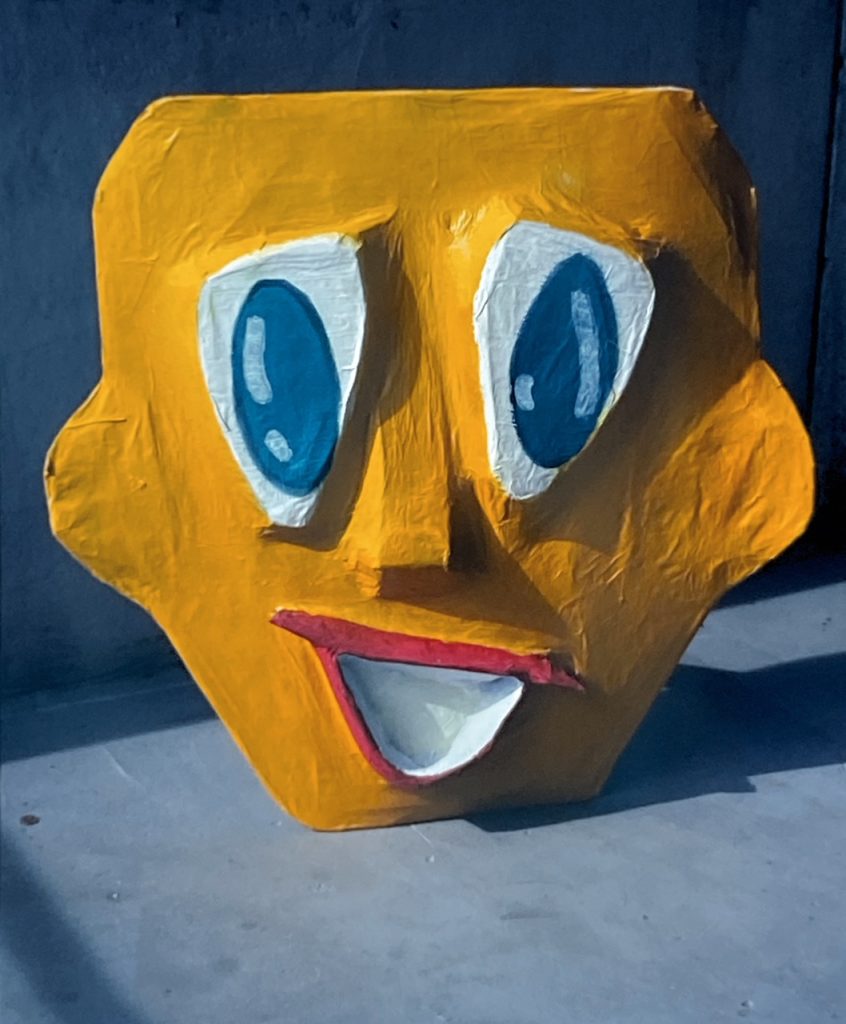
The Pinata Gigante in progress as of May seen in the photo below! Thanks to workshops on April 17, May 1 and May 8 with students from the Boys and Girls Club here in Edenton. The cones on the floor will soon be attached to the giant sphere…then painted and crepe paper added. …later, it will be filled with sweets.

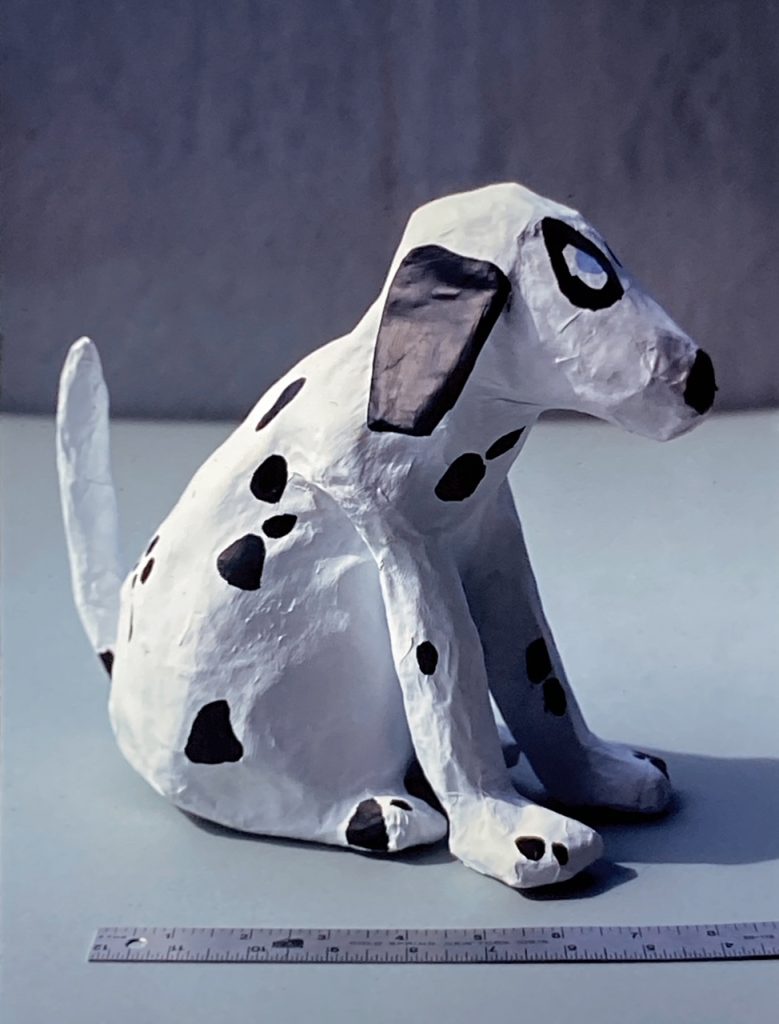
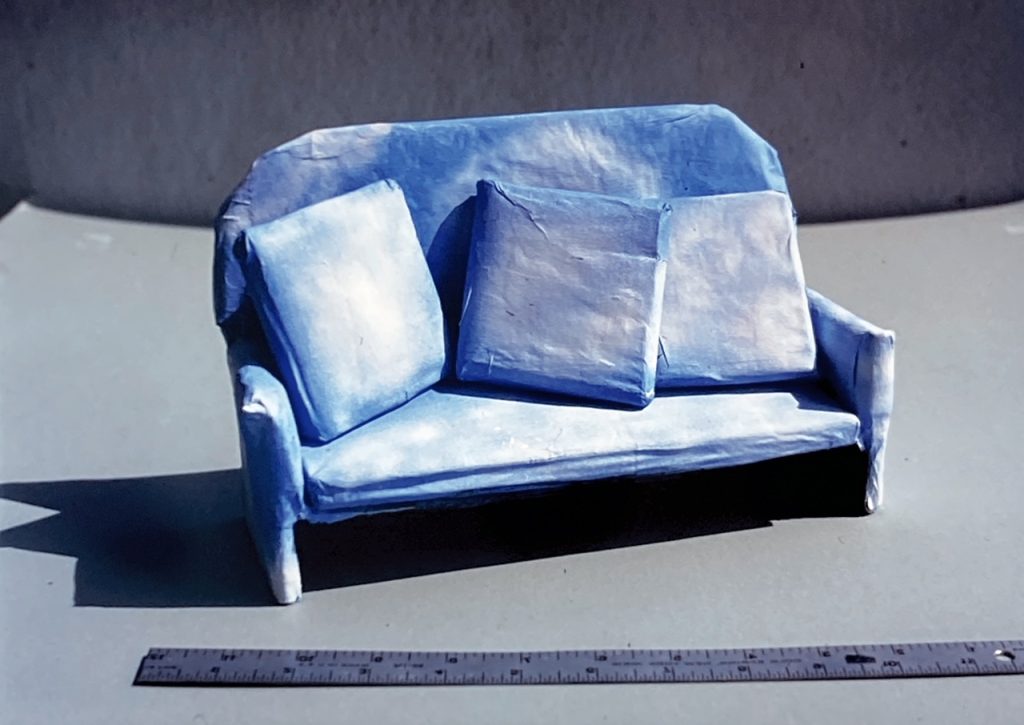
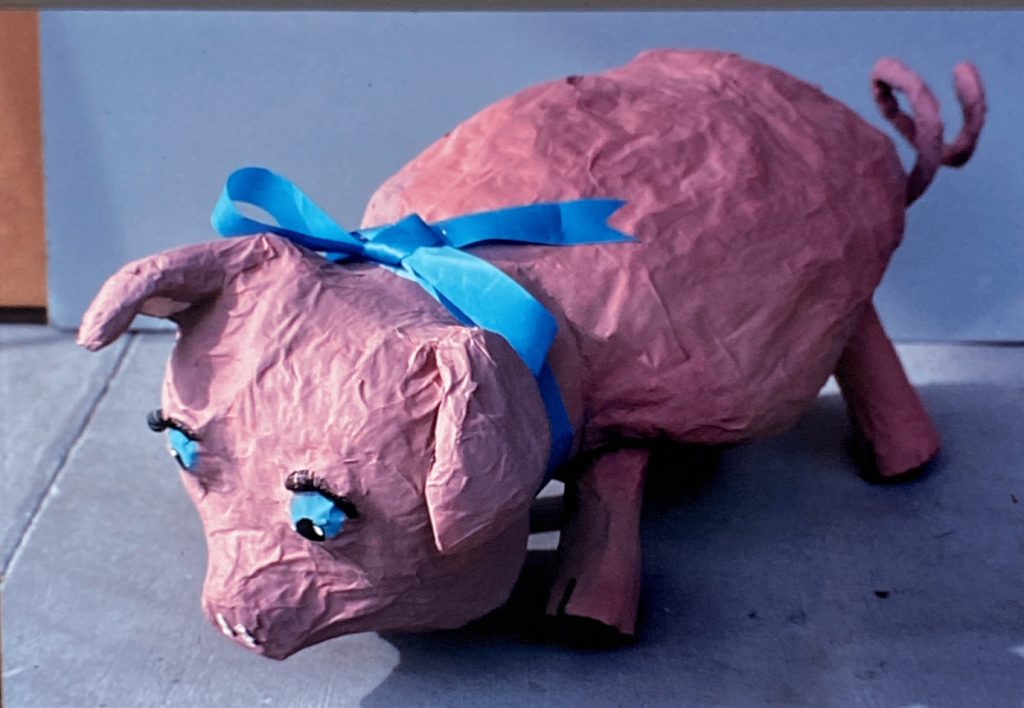
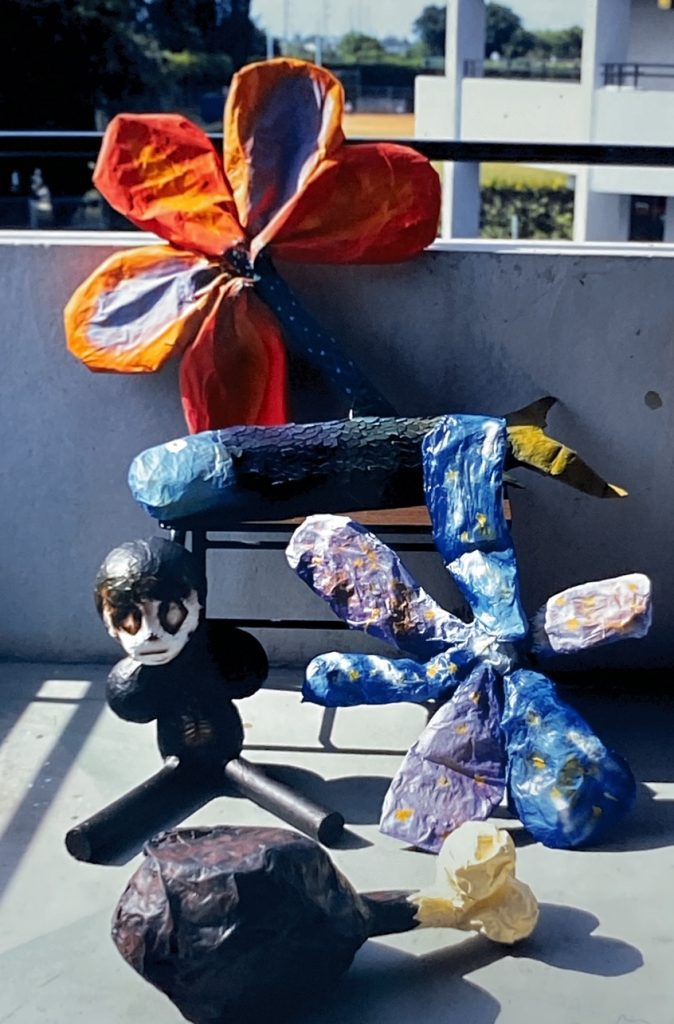
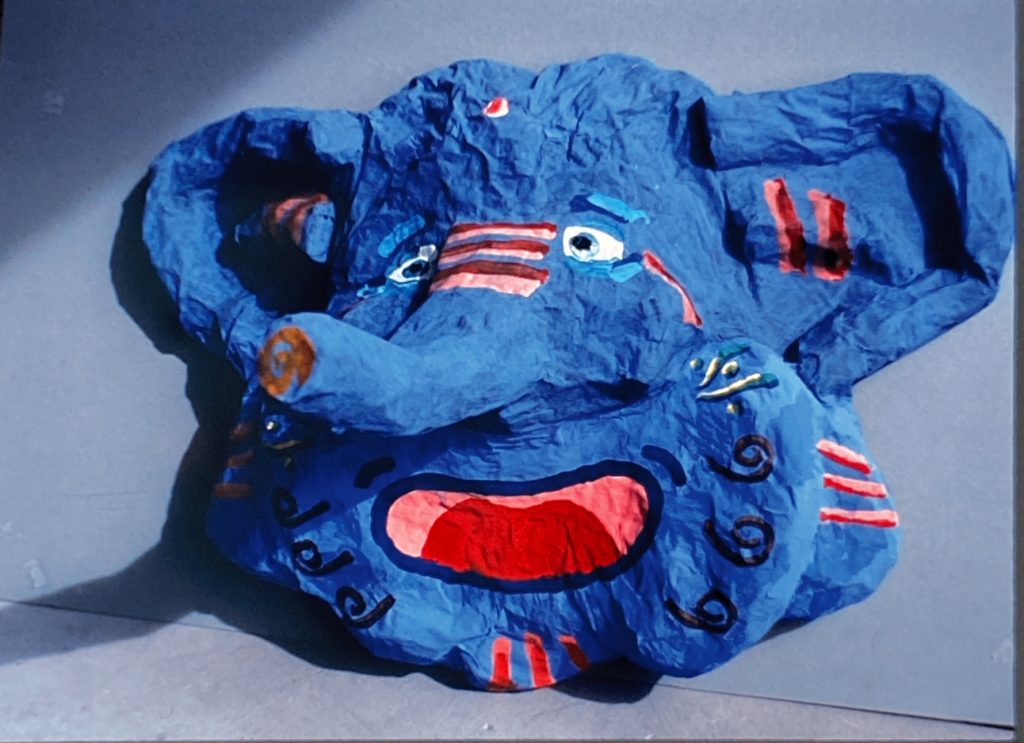
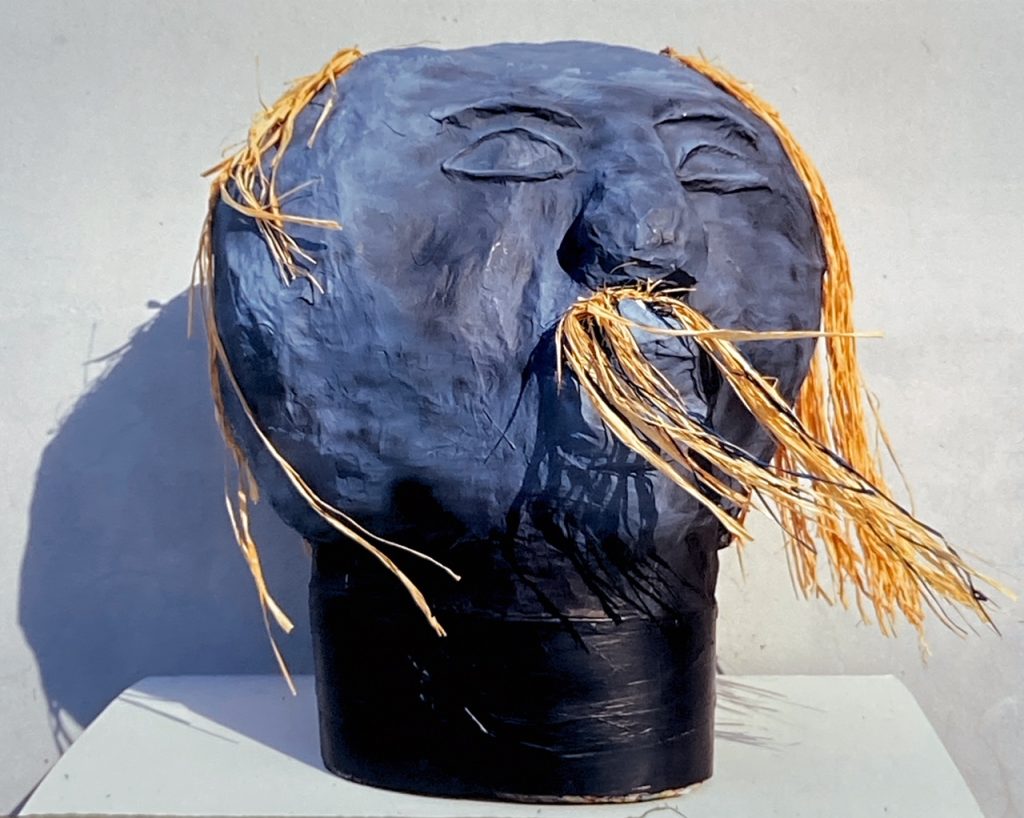
Painted paper-maché sculptures by Julia Townsend:
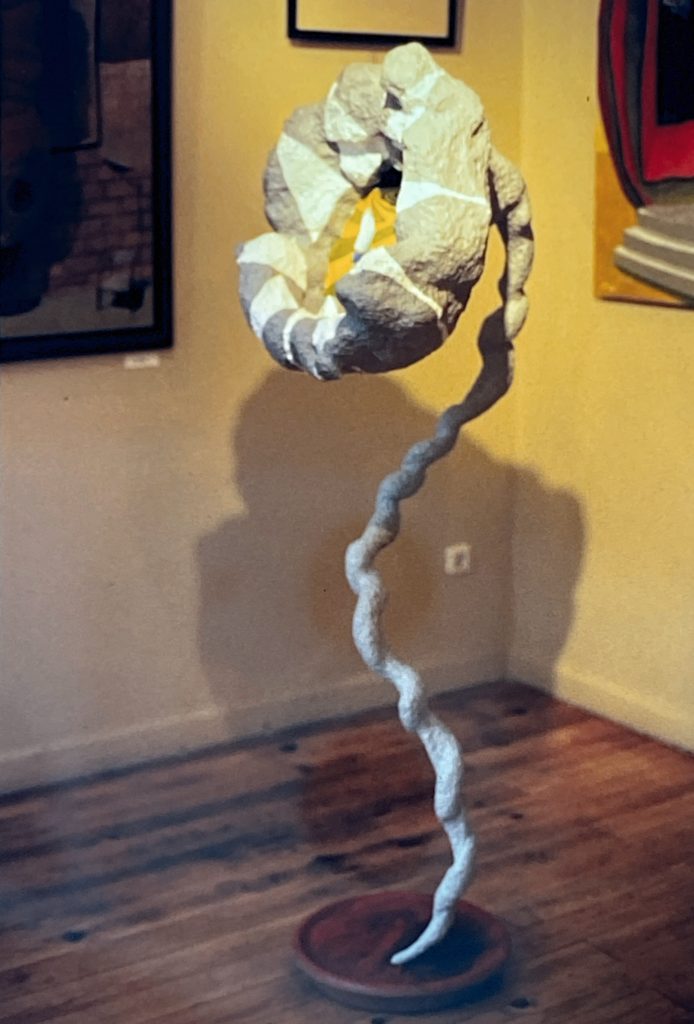
The Nuclear Flower Series: acrylic painted on paper-maché pulp, over wire and styrofoam armature, plaster and cement base
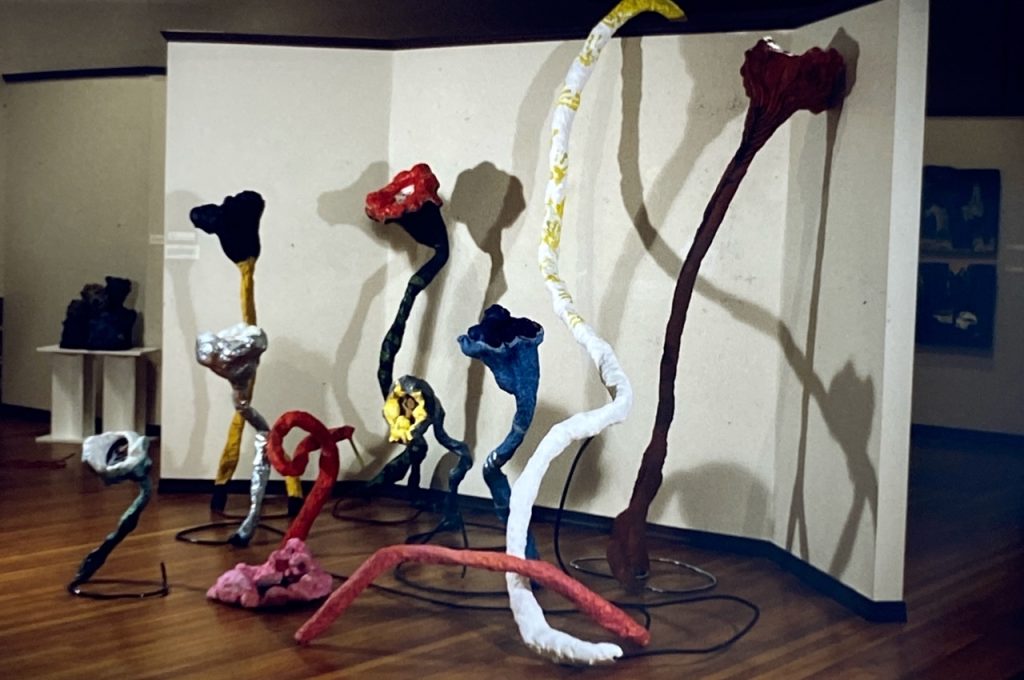
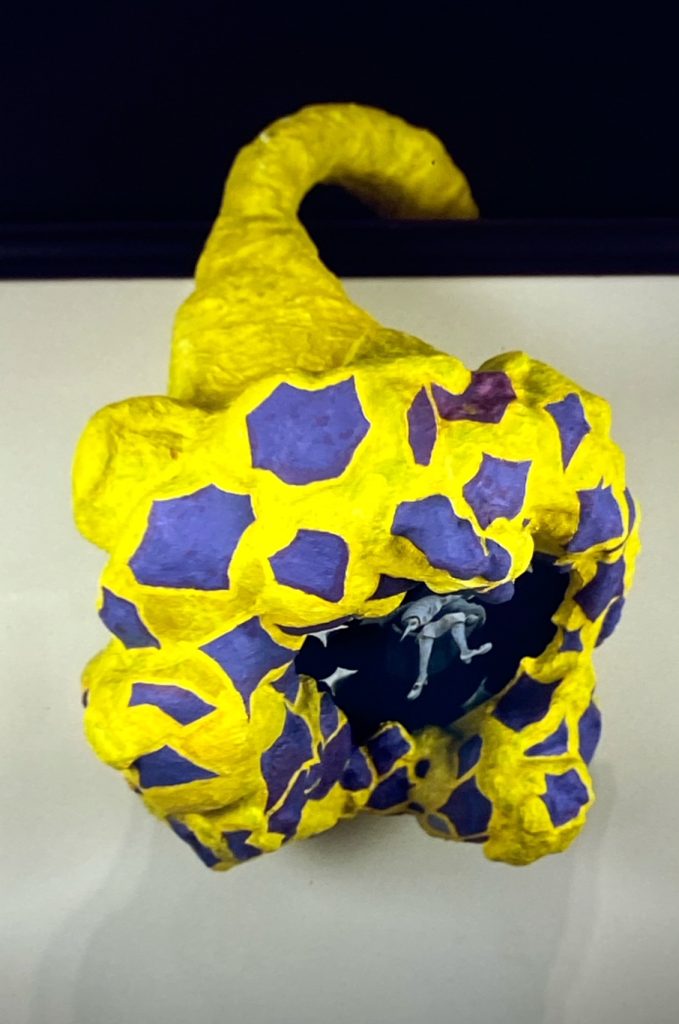
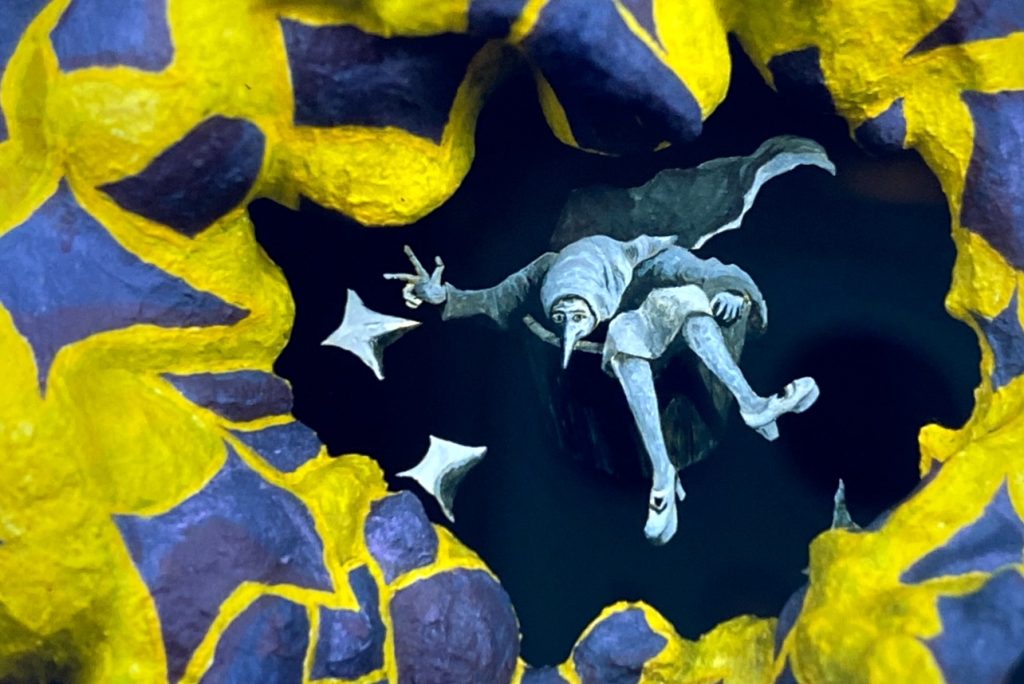
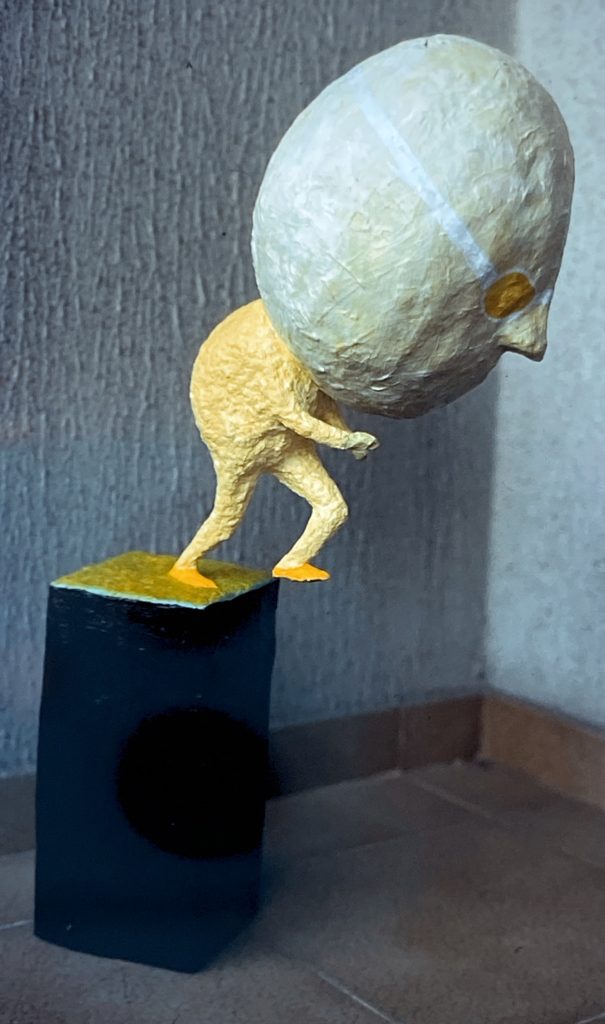
Running Man – paper-maché, paper pulp, over armature, plaster of paris base
Student work – teenagers
FEBRUARY:
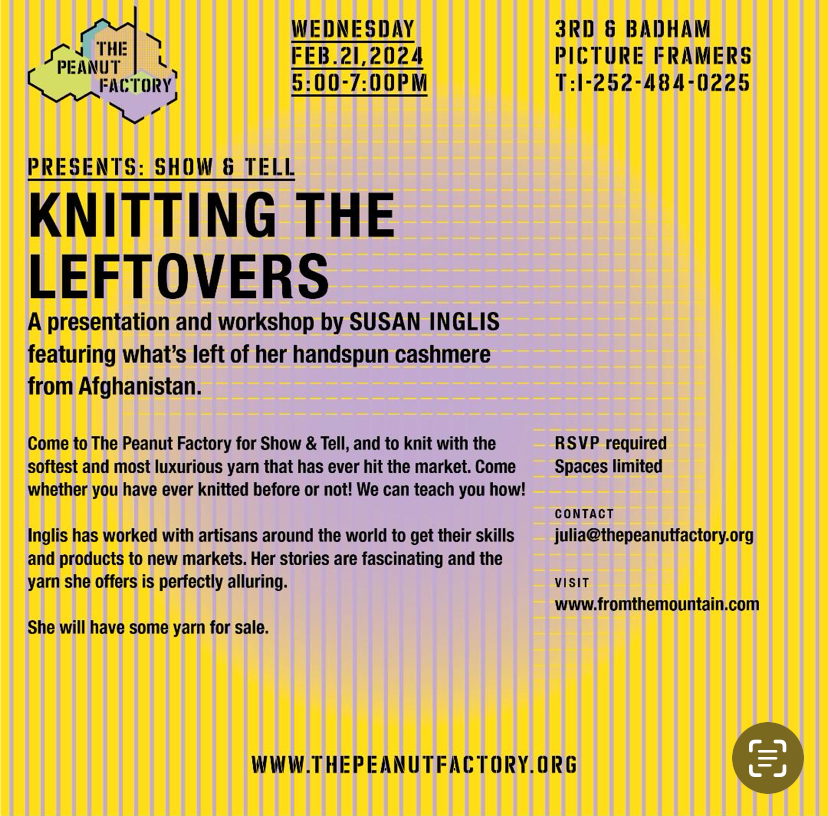
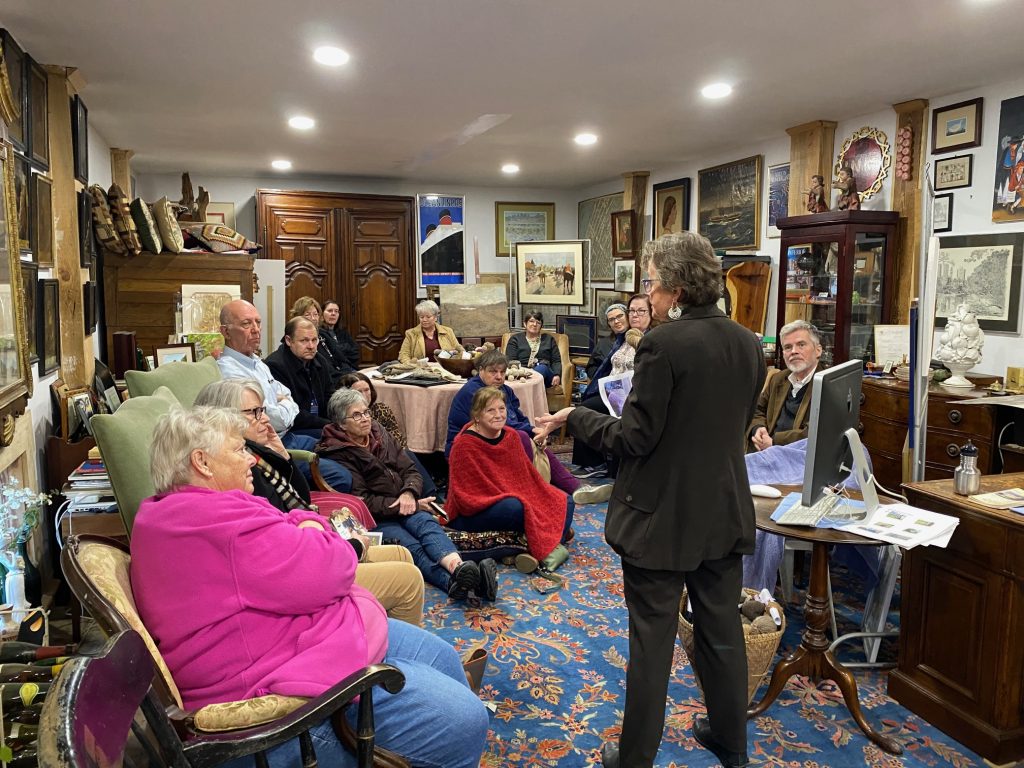
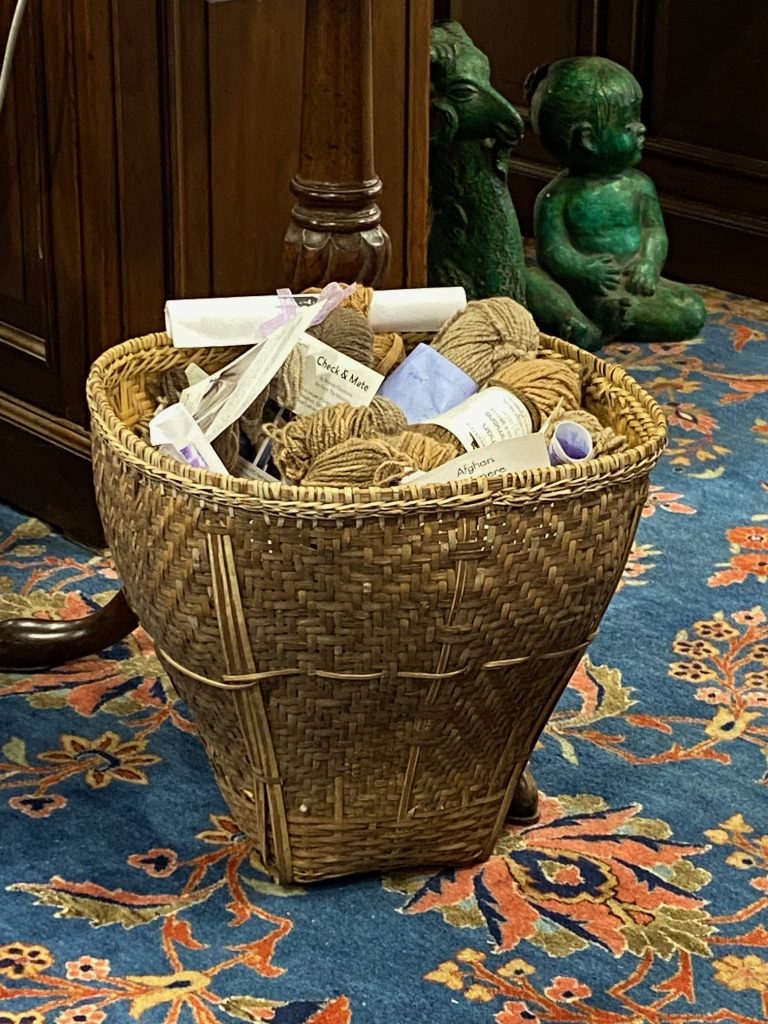
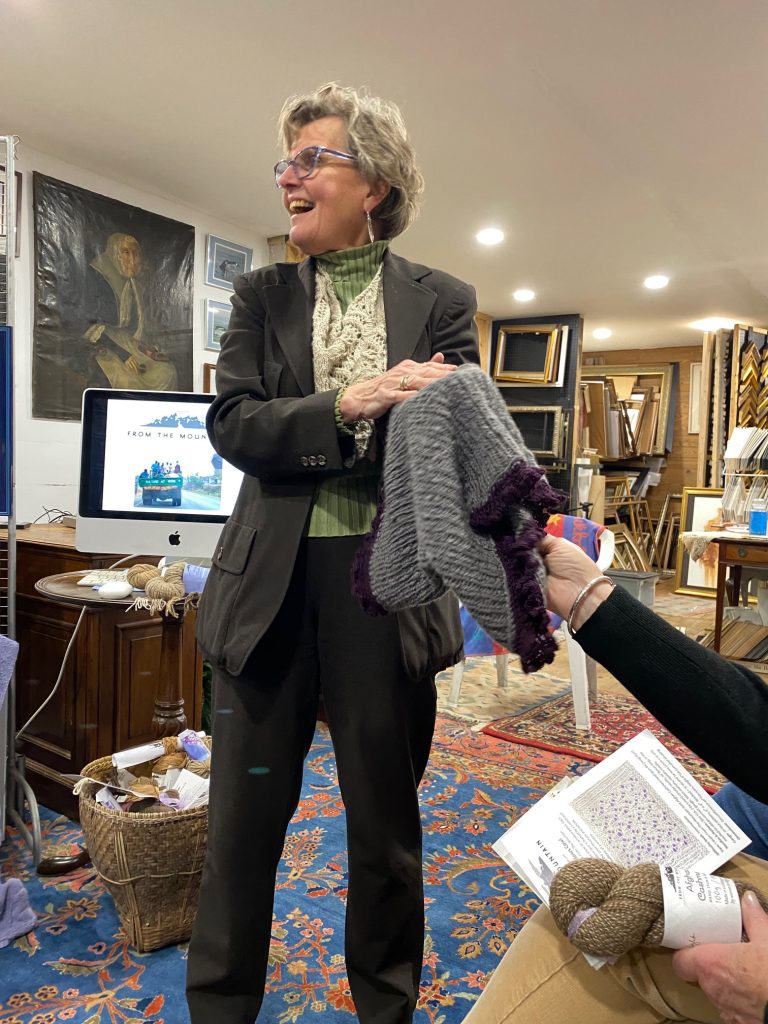
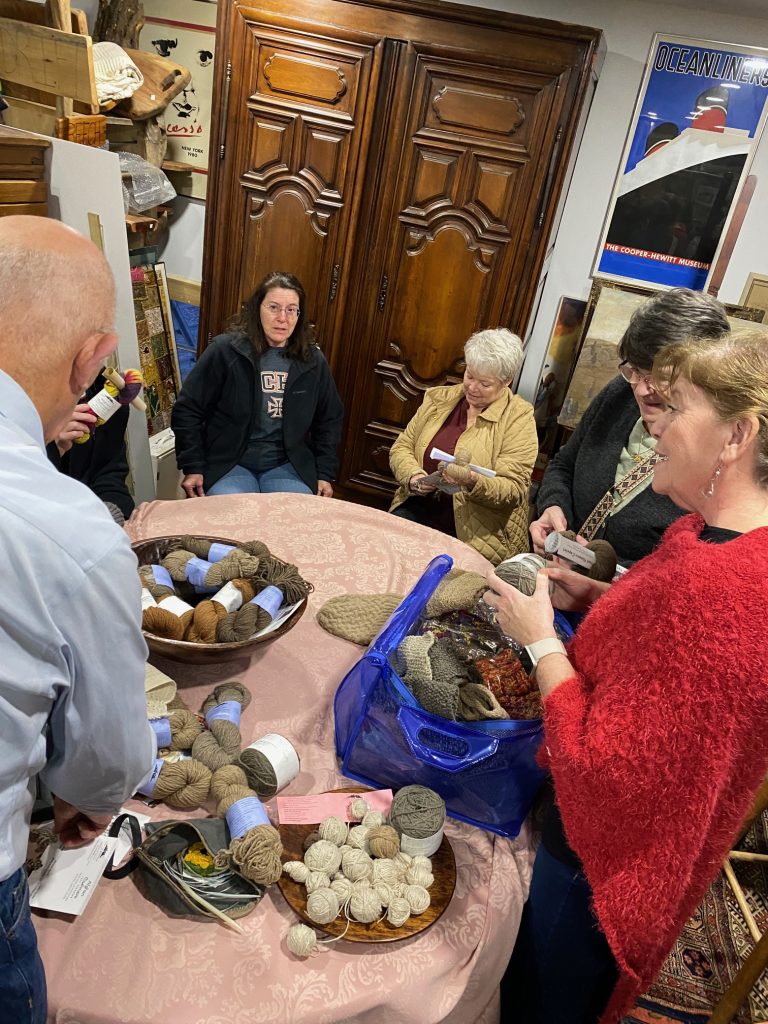
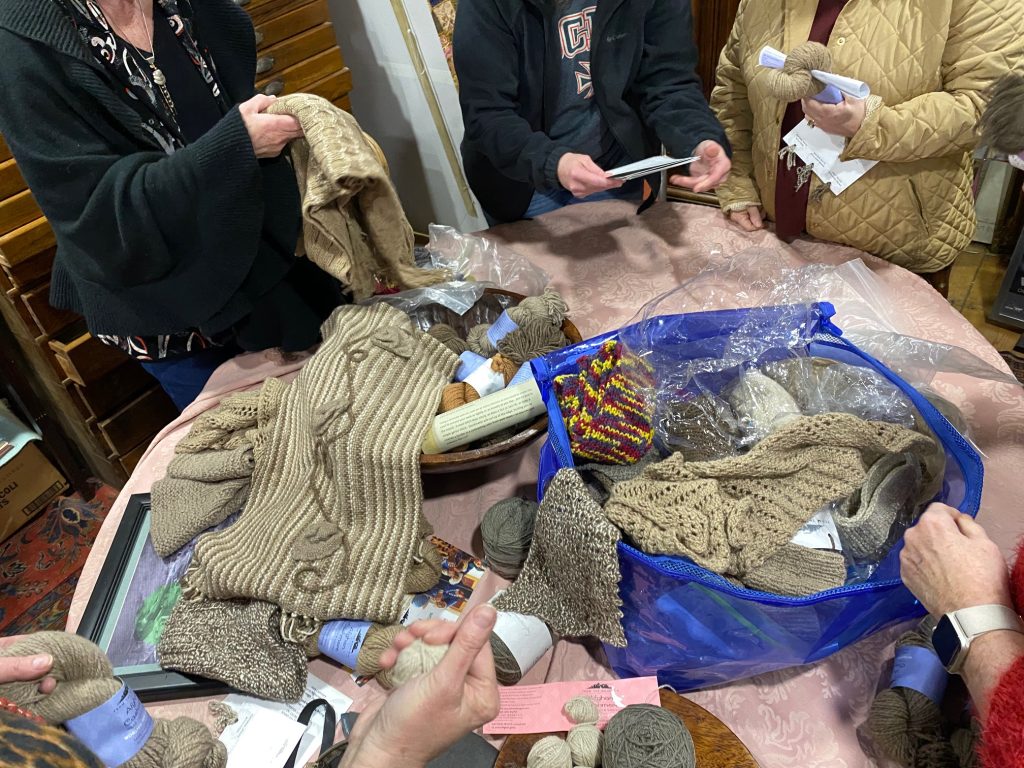
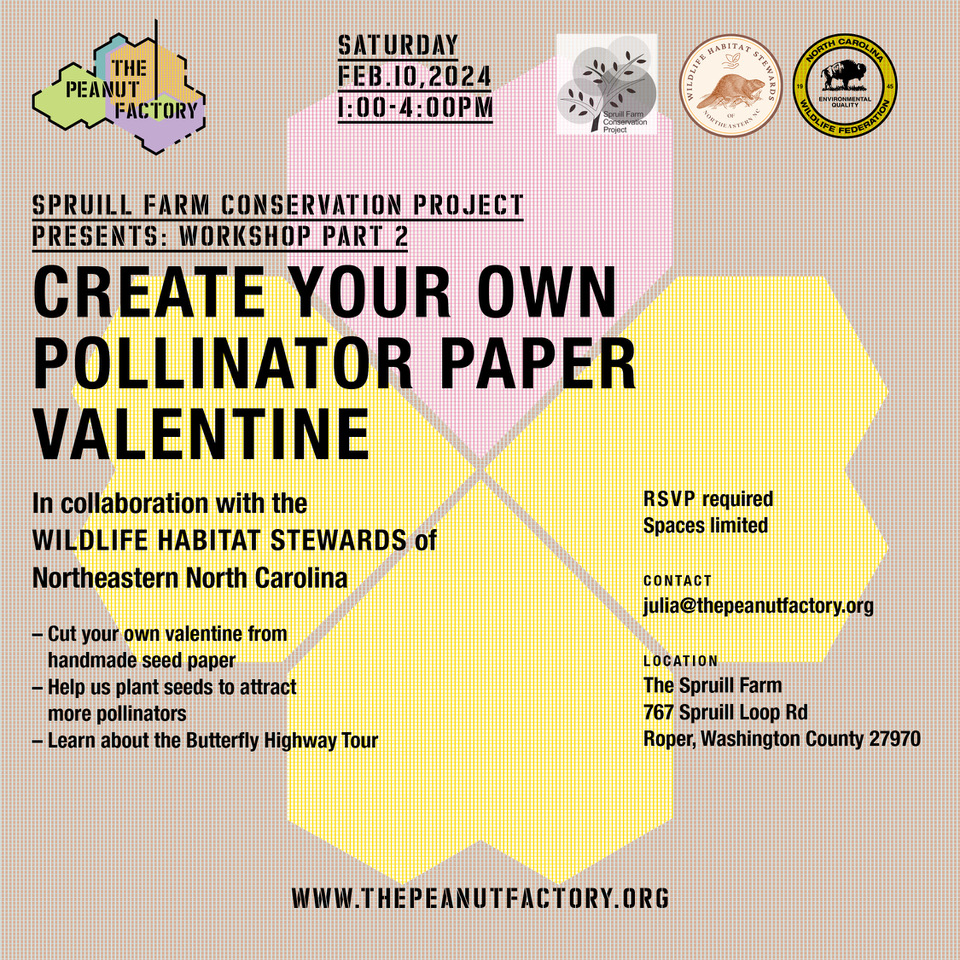
Visit https://www.fromthemountain.com/ to find out more about where the yarn comes from.
JANUARY:
The Peanut Factory announces a series of monthly workshops for 2024, beginning with a hands-on papermaking workshop with artist Sarah Ann Austin MFA, founder of the Legacy Prints and Paper Studio:
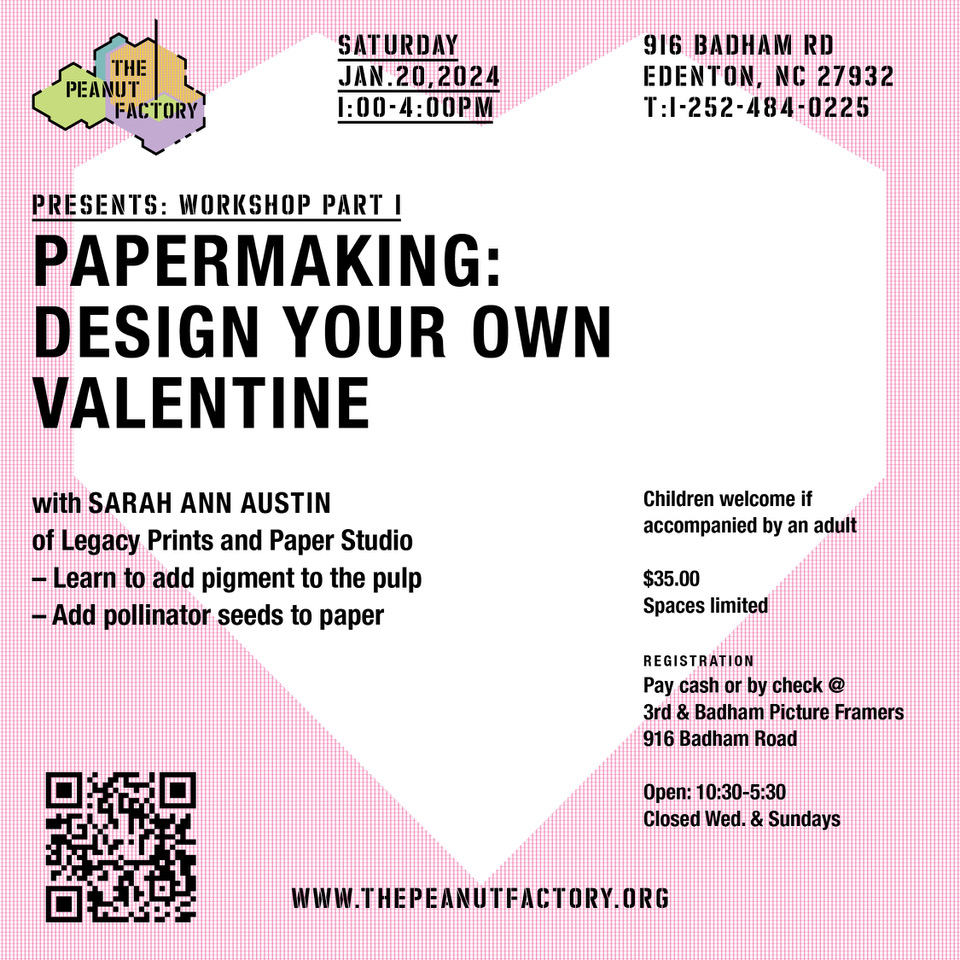
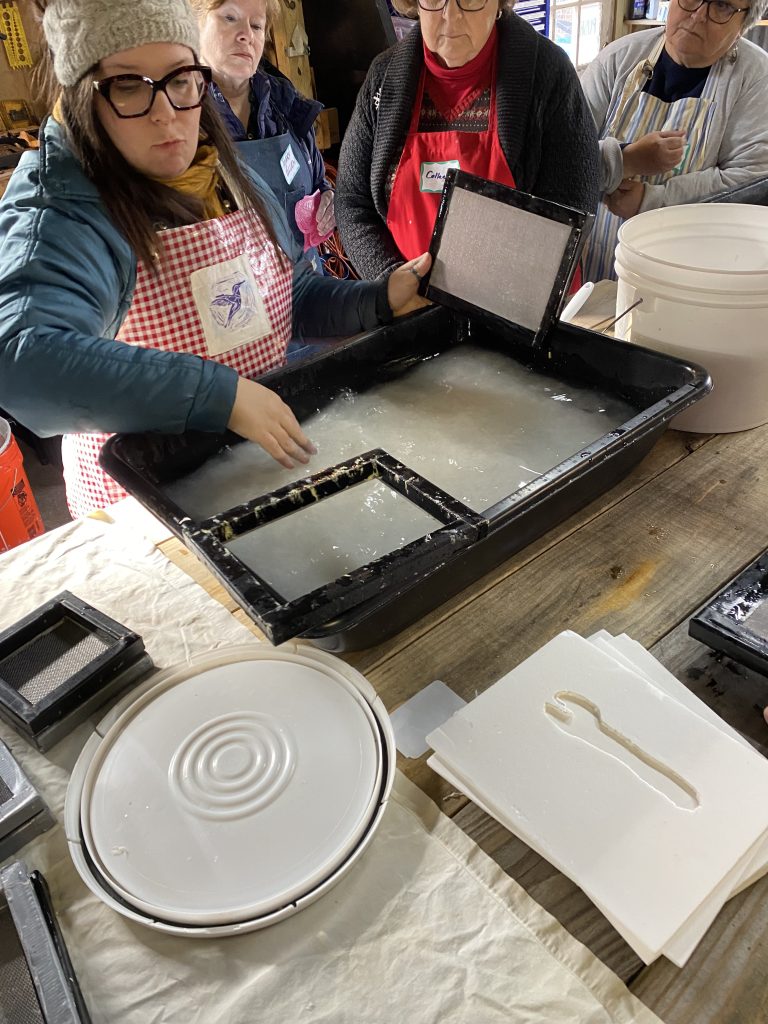
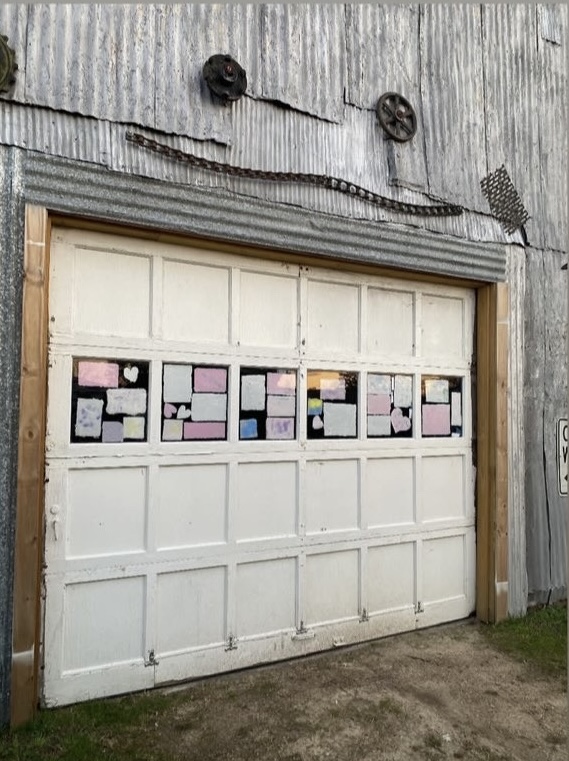
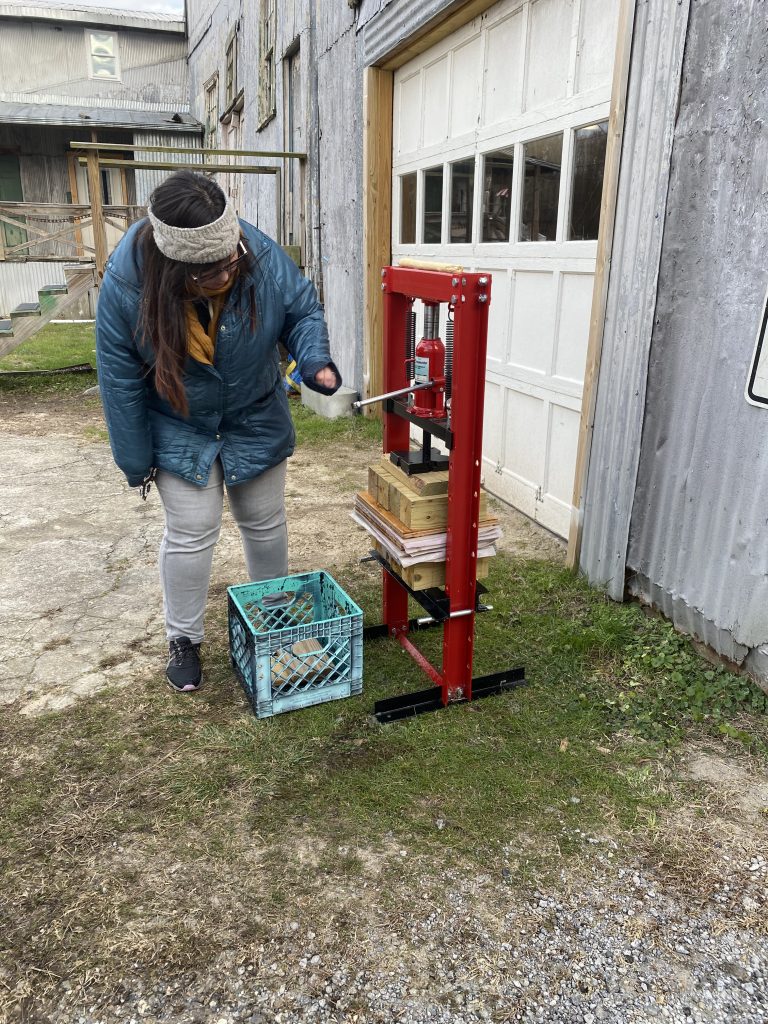
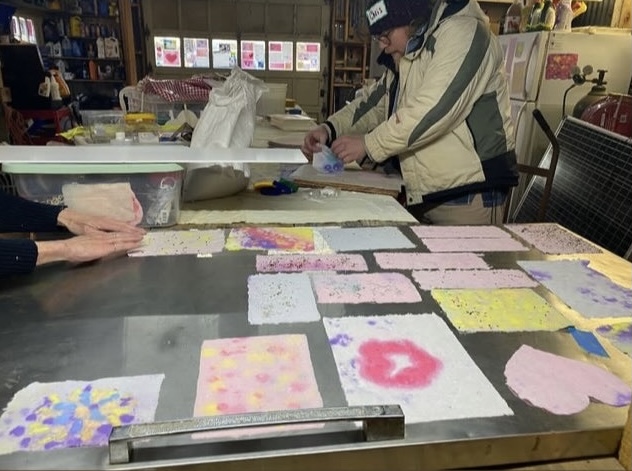
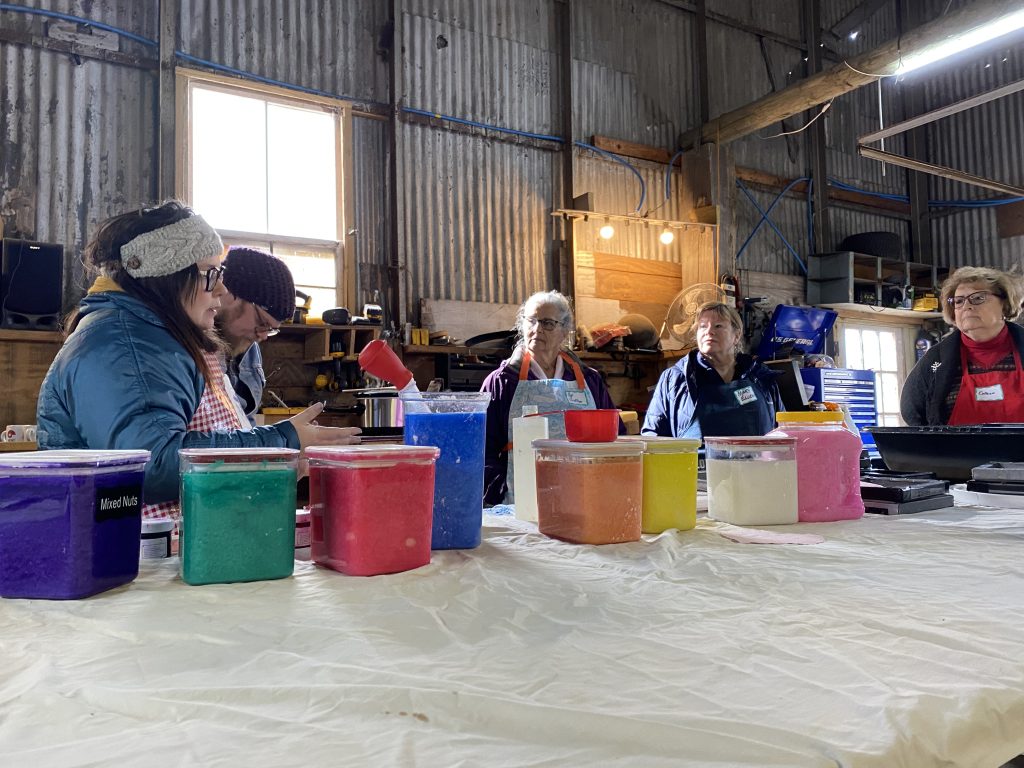
Sarah Ann Austin is a Raleigh based mixed media artist who makes historical photographic prints onto her hand crafted cotton rag, abaca, and kozo papers. Sarah Ann’s technical and historical knowledge of traditional crafts is used in her everyday practice creating paper, prints, brushes, installations, and art objects that wonderfully capture the depth and many uses of natural resources.
“My work explores the complex relationships between craft culture and fine art through process and conceptual parallels of memory and object recognition. I’m drawn to objects that hold a memory space of my childhood trauma. I see them as objects that can link to a collective past. I reconfigure these objects through historical photographic methods with both contemporary and traditional papermaking techniques. In creating photograms of objects, I am capturing their distinct likeness and reclaiming them into new images that are beautifully and ornamental.”
Born in Flint, Michigan, Sarah Ann Austin received a BFA in Visual Communications and Studio Art from The University of Michigan and a MFA in Studio Art focusing in All forms of Photography, Sculpture, and Papermaking at the University of Alabama. She has taught at universities and community centers since 2012 and has exhibited her Art in various group and solo exhibitions throughout nationally including: the Ogden Museum of Southern Art, Birmingham Museum of Art, Flint Institute of Art, Detroit Institute of Art, Oklahoma Museum of Modern Art, Gadsden Museum of Art, Bradley University, Un. of Michigan Museum of Art to name a few. Sarah Ann has received grants and fellowships from Ohio Arts council, FotoFocus, Society for Photographic education, AL Arts Council, University of Michigan, University of Alabama, Greater Flints Arts Council, United Arts Council and more. You can learn more about Sarah Ann’s work with non-profits and upcoming classes at the Crafts Center at NC State, Artspace NC, Art-For-All, Baltimore Clayworks, and with Raleigh Arts on her website and Instagram
2023:
Past
2023

2022
2021